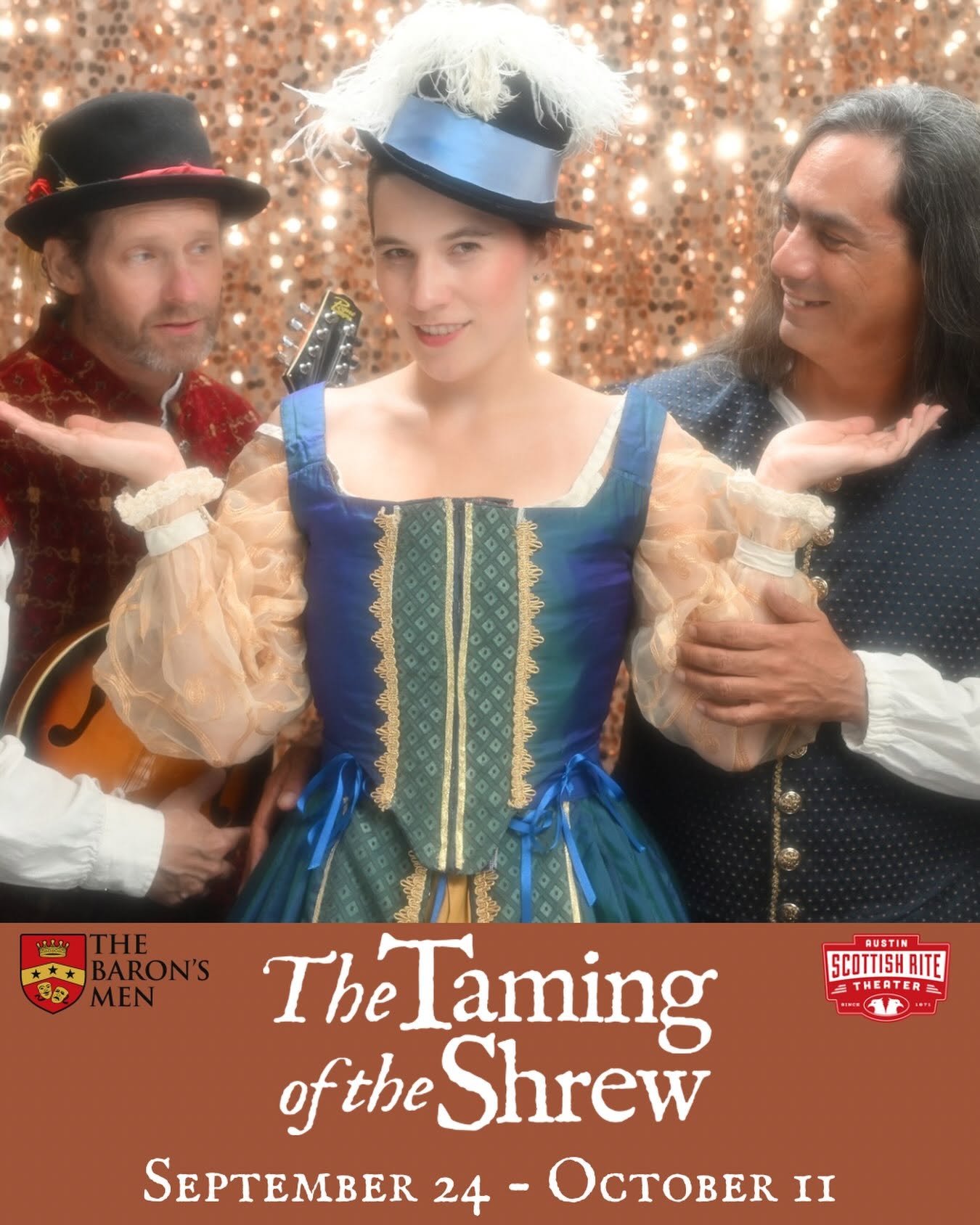
Review: The Taming of the Shrew by The Baron's Men
by Michael Meigs
 We all lamented the sale last year of the grounds beneath the Curtain Theatre in the far west of Austin, where the Baron's Men had performed for twenty-five years. There was something heady, even ineffable, about witnessing Shakespeare's plays performed quasi-outoors in the quarter-sized replica of London stages of the time of Queen Elizabeth and King James. The night air, the view of the bare thrust stage from the two-storied stands or from the groundlings' benches below; even the annoying party sounds from boaters out there on the Colorado River added to the experience.
Nothing daunted, the core company continues with familliar faces, some of whom I've followed for more than fifteen years. The Baron's Men have the knowledge. They're resplendent in those meticulously crafted Elizabethan costumes. They deliver their Shakespeare unerringly, in comfortably middle-Atlantic accents. Most pleasing of all, they respect the texts and they have fun.
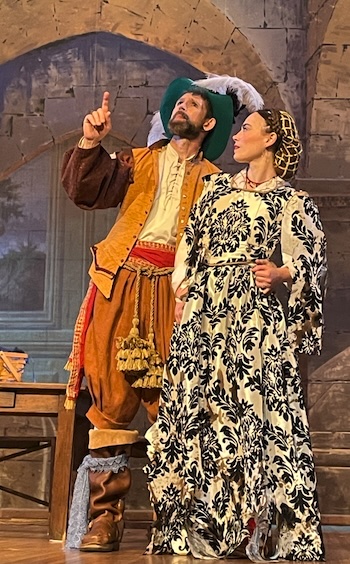
Those aspects haven't changed with their transition to the Scottish RIte Theatre on 18th Street in central Austin. In fact, they've been magnified. Picture it: a move from the 270-degree spectacle at distance out of doors to a tidy 200-seat proscenium theatre constructed in the nineteenth century. Focus is narrowed but magnified; wide-ranging spectacle becomes sparkle, and the players are much closer to the audience. The company takes full advantage of the SRT's carefully conserved antique backdrops, adding impressive visuals and changing them during brief blackouts timed by a clatter and rattle from the back of the house. The visual transformation is striking, as striking as the impact of the authentic costuming the company has always used.
It's as if the Baron's Men had unexpectedly transported from 1600 to the late nineteenth century of Sir Henry Irving, Dame Ellen Terry, and Sarah Bernhardt. Different, yes, but just as fascinating and fully realized.
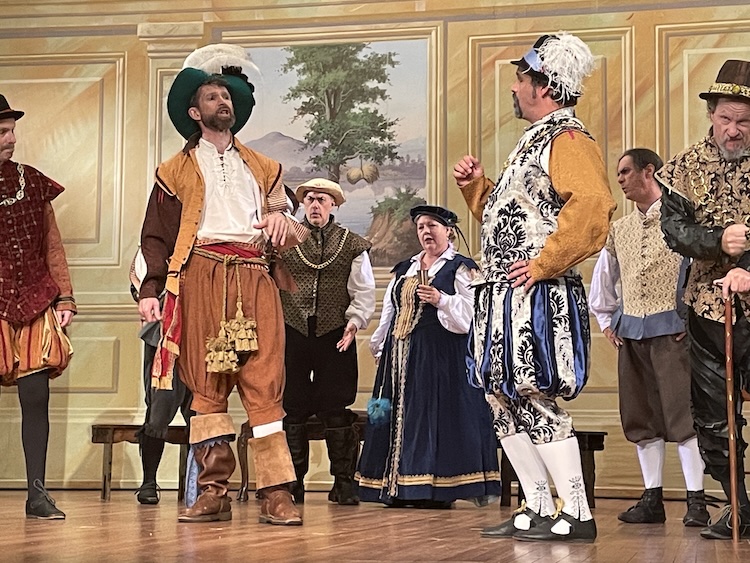
This comedy of Shakespeare moves swiftly, throwing at the audiences characters not unlike those who might have appeared in the commedia dell' arte: ardent suitors blocked by a father patriarch, a sweet young thing, a shrewish older sister no one wants to wed, an assembly of cunning servants and lackeys. But Shakespeare gives them depth and character. This isn't knock-about comedy; rather, it's the clash of wills, the guile of duplicity, and courtship, all of it credible and fully motivated.
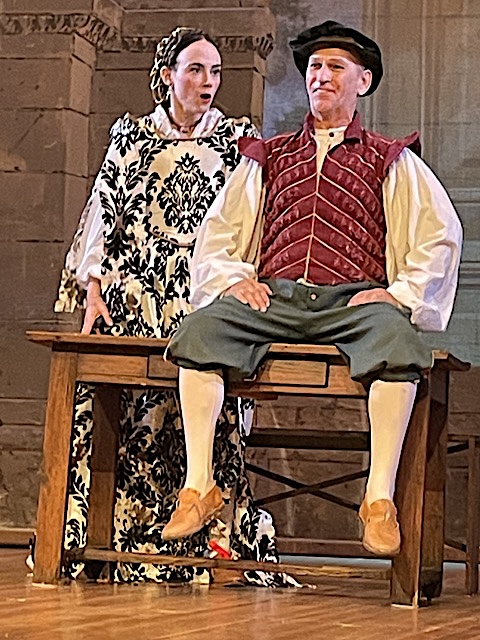 Katarina the older sister is the focus and title character. She could be played as a vile-tempered man hater, and probably has been. Director Jacquelyn Lies and Shannon Gibson in that role give Katarina the intelligence and sharpness of Beatrice in Much Ado about Nothing. As her determined suitor Petruchio, Andy Bond again proves his fluency and intention in iambic pentameter while making the man not a madcap or a brute, but an outsider intent on making his way in the world.
Familiar faces give the secondary characters depth. Julio Mella as Lucentio, chief aspirant to the hand of younger daughter Bianca, is again a funny, goofy presence, much as when he portrayed Falstaff in The Merry Wives. Robert Deike makes old Gremio, rival pretender to the fair Bianca, an wrinkled-face agéd clown. Timothy McKinney as Petruchio's servant Grumio is a canny trickster. Gene Storie's a fine, baffled traveler recruited to play the part of fake Lucentio's father. And on, and on; virtually everyone in this sixteen-member cast has trod the boards of the Curtain Theatre. Often and repeatedly. There's lots of clever stage business, and you're even treated to the oft-eliminated prologue featuring Christopher Sly.
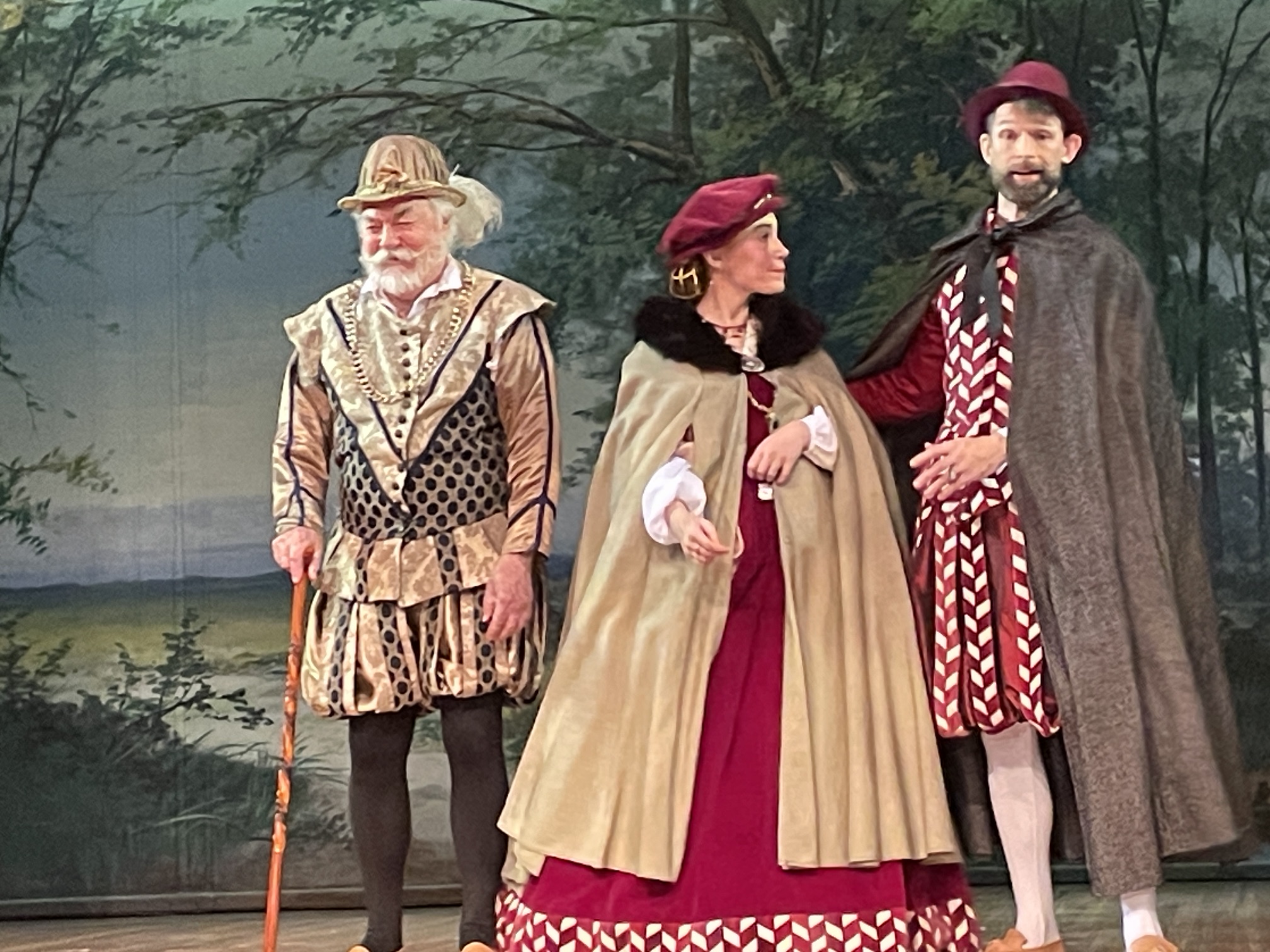
In our day, The Taming of the Shrew poses a fundamental problem to any director. Keenly conscious that women are entitled to their own agency, neither chattel nor cattle, how do director and actors interpret a text that mocks women who reject male domination? Director Lies sees Katarina and Petruchio as scorned outsiders who eventually ally in defiance of social convention, but for me that message wasn't entirely clear. Gibson's Kate speaks with appropriate indignation and barbed tongue, Bond's Petruchio is patient without becoming supercilious. There's a hint of reconciliation in the scene when Kate amuses traveler Storie with her rapid changes to accommodate Petruchio's absurd contentions, but that message doesn't endure.
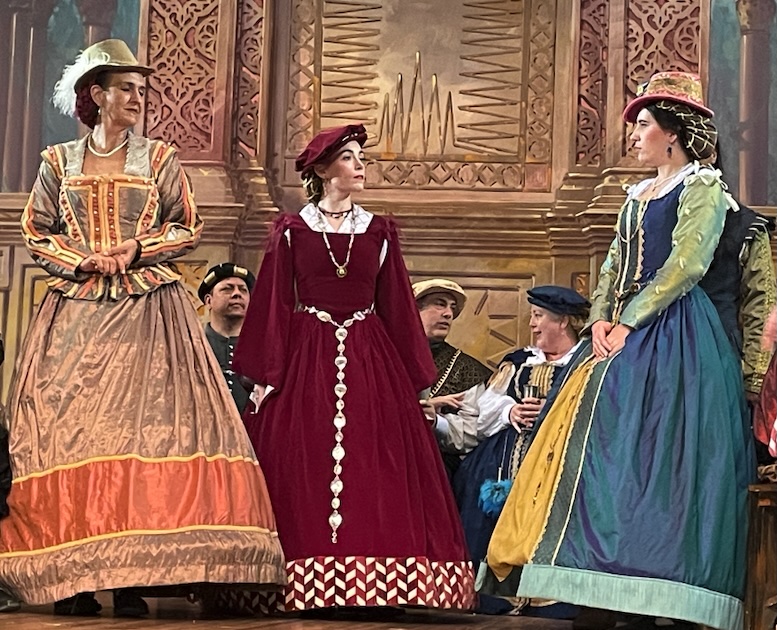
The final scene, a banquet, assigns Kate the duty of lecturing two froward wives. Gibson's lengthy speech contains not a whiff of mirth or sarcasm. She speaks the words eloquently but with a tight countenance, pronouncing her reprovals au bout des levres (reluctantly, grudgingly). As befits a woman aware of the undeserved disadvantages that persist in this twenty-first century of ours, more than four hundred years later. By no means does this spoil the fun of what went before; but it reminds us marriage can be a trap just as easily as a liberation. Everything depends on the partnership.
EXTRA
Click to view the Baron's Men's program for The Taming of the Shrew
The Taming of the Shrew
by William Shakespeare
The Baron's Men
September 24 - October 11, 2026
September 24 - October 11, 2026
Scottish Rite Theatre, Austin