Review: Bisexual Sadness by Jarrott Productions
by David Glen Robinson
Bisexual Sadness by upcoming playwright India Kotis has opened at Trinity Street Playhouse in downtown Austin, the second-ever production of anew work which may have a bright future. Surely, Jarrott Productions' staging will assist its launch.
A one-act about 90 minutes long, Bisexual Sadness is loaded with content about sexuality in its many refractions. Opening night attracted a full house fascinated with the topic. It's a comdrama, a comedy that becomes a drama, in contrast to a dramedy, a drama which contains or becomes a comedy. I may have invented the term comdrama. iI so, apologies.
This was a dialogue piece. As in many a Shakespeare play, all the characters tell self-justifying stories. Some come as orations, some in quiet after-party moments, some in drunken arguments, and some in other subtle ways.
The cast was well rehearsed by director Will Gibson Douglas, who realized an expansive stage vision to accommodate a play with considerable complexities. Jarrott Productions veteran Kelsey Mazak plays Faye, a woman in her late twenties. The aptly entitled play articulated its themes almost entirely through her.
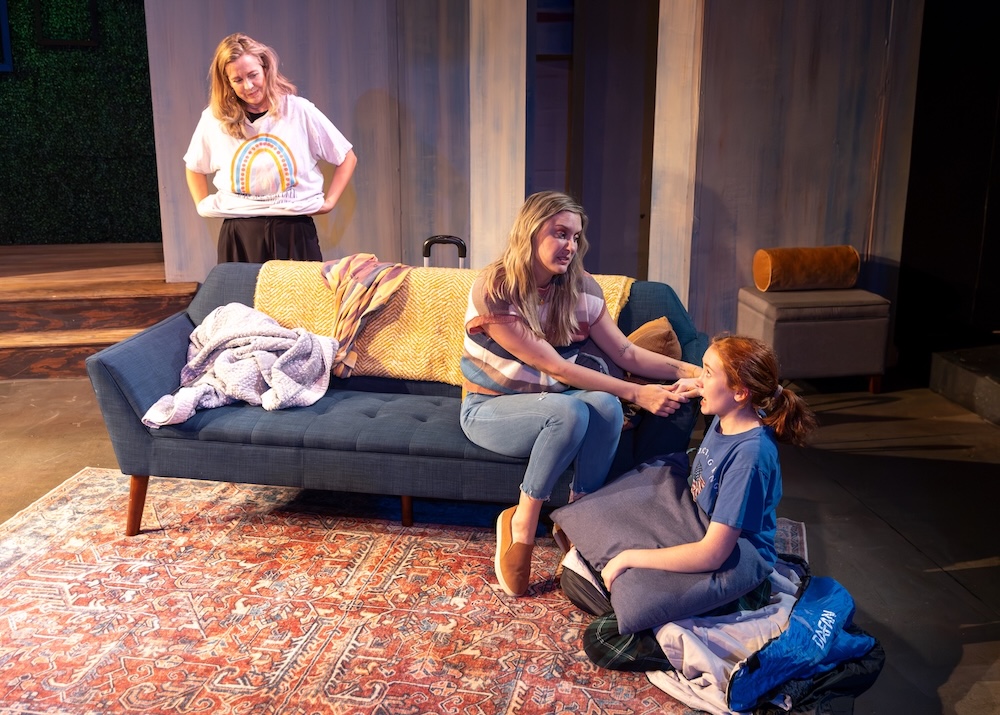
Faye’s former lesbian lover Genevieve, still her best friend, was played by CB Feller, and Faye's current fiancé Alex was Christopher Gonzalez. The older sister who came to live with Faye and Alex was Miranda (Catherine Woodiwiss). Miranda arrives with her withdrawn teenage daughter Naomi, played by Violet Bolton. And Jacqui Calloway appears as Lillian, Genevieve’s uninhibited current lover.
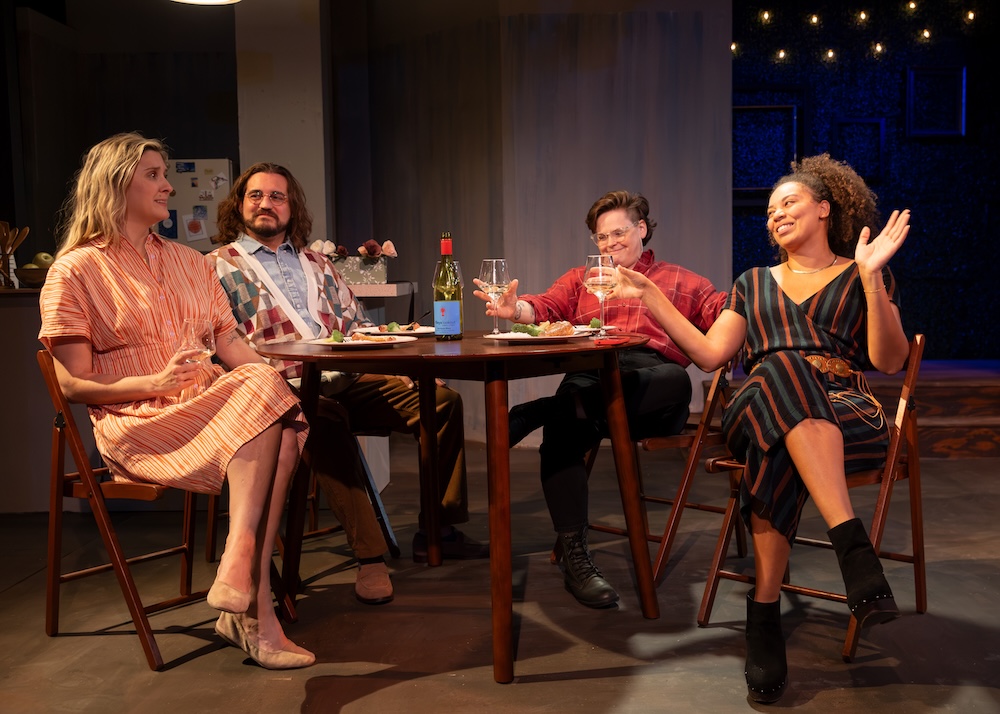
Several of the initial character-establishing dialogues of modern chit-chat about mundane things were delivered in low tones that couldn’t hold audience attention for long; and, note to the playwright, some of the dialogues could have been shortened. Otherwise, the play overflowed with both serious and comedic content. Only a few highlights can be described in this space.
Jacqui Calloway is an expert comic actress. At the dinner party, her character Lillian regaled everyone including the impassive teenage daughter Naomi with the details of lesbian dildo action. Lillian declared that one must own different sets of dildos, using them separately on one’s wife and one's girlfriends. That way, it’s not cheating!
The mother-daughter relationship of Miranda and Naomi relationship mirrors many in American life today. Miranda is a privileged, high-strung, self-obsessed, shallow ditz. And all that came before everything was gummed up further by an impending divorce. Teenage Naomi is getting nothing from the fam. She deserves a lot of support. She declares herself to be a non-binary “them,” apparently without any precipitating crisis or change. But Mom's freakout is beyond imaging. We are dragged comedically through the current muddle with pronouns.
In her bonding dialogue with Aunt Faye, Naomi says “Mom cried,” at another point “Mom cried a lot.” Those were signposts along the way to Naomi's declaration that nobody understands her, especially not Mom. Faye was sympathetic to her sister Miranda’s tears, but Naomi seemed unmoved by her mother’s plight. Naomi’s declaration of non-binary status showed she was erecting defensive barriers against an overbearing parent. It was passive-aggressive; Naomi’s redefinition of self appeared completely unrelated to sexuality and gender. Her schadenfreude at Miranda’s pain was cruelty. Ditzy Miranda, shallow, stressed, and unknowing about many things, didn’t deserve that.
The play rose to a culmination rather than a climax, a plateau rather than a peak. Faye engaged in two back-to-back duologues, one with her former lover and the other with her fiancé Alex, creating a butterfly structure. The wings were stories of Faye’s discontents and regrets in, respectively, homosexuality and heterosexuality. The play at that point had bilateral symmetry and fairness to both views of the sexual world. The wings fluttered and flew on colorful stories Faye told with great feelingly. The germ of Faye’s participation in both realms of sexuality, with their separate social fields and provincialisms, was the finding and keeping of acceptance in each while participating in them.
We live in a deeply divided world, stratified in part by sexuality, and Faye lamented the hard reality that neither realm accepts the other. Faye made this vivid with a thought experiment: walking into a gay bar together, she and Genevieve would gain instant acceptance, but in that same bar Faye and future husband Alex would get tjudgmental glances and the cold shoulder.
Neither the former lover nor the current lover could assuage Faye’s discontents. Nor will they assuage any of yours. In this sense, the play had anything but a happy ending. Instead, it subsided into the sense of quiet acceptance of one’s lot—refreshing after the long look at lives in turmoil.
Steve Williams's interactive set was a huge asset to the production. The house foreground was wide, with many entrance and exit points. Moving panels upstage changed the slightly raised center alcove from a bridal shop to a confectioner’s to the back wall of the house. The interiors were tastefully painted. Williams as scene designer and technical director worked with the team of Elias Merlo, Daniel A. Hernandez, and director Will Gibson Douglas. CB Feller was the scenic charge artist.
Bisexual Sadness is recommended to the knowledgeable; others may find it a bit opaque. Its insight and lessons are available to all.
The play runs from November 5th—22nd, 2026 at Trinity Street Playhouse, downtown Austin.
Bisexual Sadness
by India Kotis
Jarrott Productions
Black Box Theatre, 4th floor, First Baptist Church
901 Trinity Street
Austin, TX, 78701
November 5 - 11, 2026
Trinity Street Playhouse, 4th floor of First Austin, 901 Trinity Street
| Tickets on sale now! |
