Recent Reviews
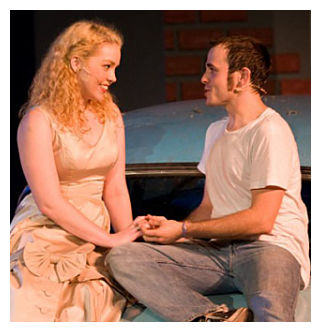
Review: Grease by Emily Ann Theatre
by Michael Meigs
Published on June 17, 2010
These characters will continue to exist in our imaginations and in their never-never land, especially when they're revived by stagings as smooth, happy and professional as this one.
The EmilyAnn Theatre in Wimberley is not outside space and time, although from Austin you're going to take a leisurely 45-minute drive through the hill country to get there. And Wimberley may be in ranch land, but it's anything but rural. Witness the presence there of two lively and effective theatre organizations, the EmilyAnn with its outdoor amphitheatre and the Wimberley Players in their snug playhouse on Old Kyle Road. Rather, it's Grease that stands …
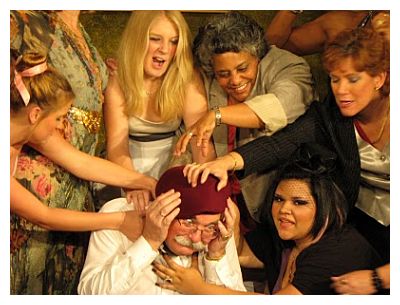
Review: Fashion, the High-Style Musical by Sam Bass Community Theatre
by Michael Meigs
Published on June 15, 2010
The Sam Bass, as a community theatre, interpreted Off Broadway spoofing amateur theatre reviving early American drama. One might recall one of those halls of repeating mirrors.
Director Frank Benge and the cast of Fashion at the Sam Bass Community Theatre played a happy triple bluff May 29 to June 12. The base text of this staging is Anna Cora Mowatt's play Fashion, or New York Society. First performed in 1845, it did not rise above the standards of the day. It's a boilerplate melodrama complete with a conniving con-man passing himself off as foreign nobility and with an ingénue playing the …
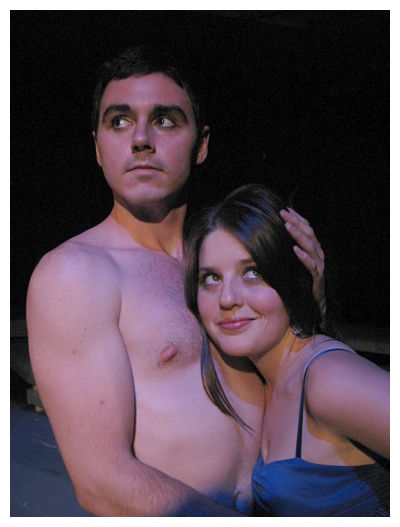
Review: Lysistrata by Chaotic Theatre Company
by Michael Meigs
Published on June 10, 2010
Chaotic Theatre's Lysistrata is an intriguing two-speed interpretation. The thesis -- never really exploited or completely explained -- is that the events we are witnessing take place in some undefined future time.
Lysistrata is a surprise in the compact canon of Greek drama. It's Aristophanes' clever satire of two usually unassociated aspects of manliness -- the male as warrior and the male as lover. Swordsmen in each case, although of quite different aspect. There's a historical context of great seriousness to it involving wars between Greek city states in B.C. 413. That may partly explain why this text was awarded only third place in the theatrical competition …
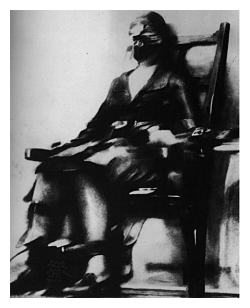
Review: Machinal by Paper Chairs
by Michael Meigs
Published on June 09, 2010
The pivotal scene between Crossno and Gabriel Luna, playing the casual seducer wafted with the winds of freedom and disengagement, is a beautifully understated passage, completely convincing in portraying the allure of this affair embraced by the young wife and mother.
This production of Machinal by Sophie Treadwell, currently playing at the Salvage Vanguard Theatre, is a memorable staging of a 1928 shocker -- which in 21st century terms means that it is endearingly two dimensional. Back in the 1920's,most American theatre art was unexciting, conventional or cast in moral platitudes. At the same time, newspaper reporting of crimes was sensationalistic and very big business. In a time when both radio and cinema were still new, …
Review: Becky's New Car by Zach Theatre
by Michael Meigs
Published on June 04, 2010
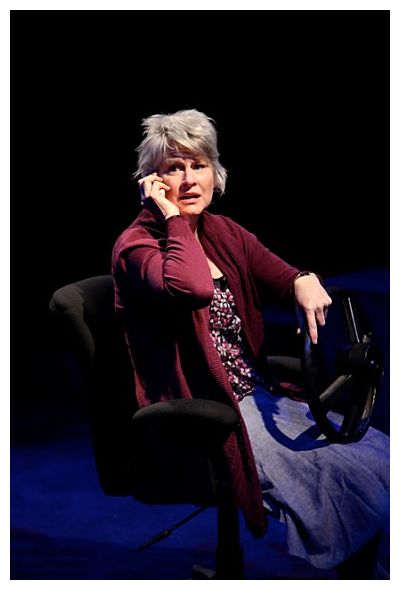
Preview night was not an adventure for Becky -- at least, not beyond the intermission -- and we walked away with the uneasy feeling that our heroine Becky Foster was stuck a long way from happiness with no towing service to call.
Zach's post card calls it "A Revved-up Comic Adventure!" The website is even more breathless, promising "[a] life-affirming comedy about an eccentric millionaire who offers Becky the keys to a brand new life [in][. . . . ] a fantastically funny exploration about class, wealth and selling out during Becky's wild ride through a clever twist of events. Huge laughs, hairpin plot turns and a story with the pedal to the metal. Buckle up!" So …

Review: Jacques Brel Is Alive and Well and Living in Paris by Austin Playhouse
by Michael Meigs
Published on June 02, 2010
If you concentrate on the words, you may get a pale and distant impression of the genius who was Jacques Brel.
This is a pleasant and inconsequential little evening of cabaret. Go and listen to the Austin Playhouse staging of Blau and Shuman's 1968 compendium Jacques Brel Is Alive and Well and Living in Paris. If you concentrate on the words, you may get a pale and distant impression of the genius who was Jacques Brel. These are the problems of translation. The music stands outside language, but Brel's stories and lyrics are deeply embedded in …