An Encomium: Austin Opera and La bohème
by Michael Meigs
.jpg) We've just learned that Austin now has a population of more than one million and is the twelfth largest city in the country. How things have changed! Long gone is that slogan Keep Austin Weird and only marginally relevant is its official successor Live Music Capital of the World. To be replaced by—what? Perhaps by nothing at all. Perhaps our town has grown up and gotten to be a city of complexity, creative, and self-awareness, not a place that has to hawk itself to tourists (tell that one to the convention center project, won't you?).
We've just learned that Austin now has a population of more than one million and is the twelfth largest city in the country. How things have changed! Long gone is that slogan Keep Austin Weird and only marginally relevant is its official successor Live Music Capital of the World. To be replaced by—what? Perhaps by nothing at all. Perhaps our town has grown up and gotten to be a city of complexity, creative, and self-awareness, not a place that has to hawk itself to tourists (tell that one to the convention center project, won't you?).
Reflecting that change and growth is Austin Opera, currently celebrating the 40th anniversary of its founding. AO istages productions of stunning quality and over the past ten years has gathered in lots more supporters, sponsors, and audiences.
It wasn't ever thus. In the days it was known as the Austin Lyric Opera, the company had fallen on hard times. In 2011 trailing deficits forced it to sell its headquarters building on Barton Springs Road behind the Long Center and to divest itself of the Armstrong Community Music School it founded a decade earlier. The ALO was obliged to rent, often in inconvenient spaces, though its productions still took place in the vastness of Dell Hall. In the mid-teens the staff and board changed its title to Austin Opera, dropping the diminutive "Lyric." The Austin Statesman reported that General Drector Joe Specter said the change was "meant to reflect the professional stature and forward-thinking of the company. We’ve been known as Austin Lyric Opera for many years, and it has served us well. It is an important part of our history, and we are proud to be an opera company with that kind of longevity. As Austin continues its remarkable growth, we want our name to let people know that we are offering the kind of sophisticated opera experience that suits our creative and thriving city. As a name, ‘Austin Opera’ is elegant and inviting.”
Elegant and inviting weren't sufficient in themselves to power a comeback. That same year AO recruited Annie Burridge as general director and CEO. Burridge came from nine years on the staff of Opera Philadelphia, where she'd become managing director. AO's profile of Burridge notes, Upon arrival, she led the development of the company’s new strategic plan centered on artistic growth, innovation, and civic engagement. She launched a new artistic initiative – Opera ATX – bringing groundbreaking artists to unexpected and unique venues throughout Austin; appointed the company’s first Curator of Hispanic and Latinx Programming funded through the creation of the Butler Fund for Spanish Programming; established a new model for co-production partnerships; secured four national innovation grants totaling $800,000; established numerous community partnerships including the Consulate General of Mexico in Austin; and tripled the company’s endowment funds."
It wasn't all smooth sailing. A nasty personnel problem involving a very senior staffer in late 2017 didn't help. And then there was COVID, which shut down all theatre activity for more than a year. Determined to re-start programming, Burridge and the artists planned an outdoor staging of Tosca, socially distanced, for late April and early May of 2021. A rainstorm destroyed the set a week before the opening, but they persisted. The opening was memorable, in a laugh-about-it-now kind of way. Mist swirled and showers fell; we huddled under our umbrellas as the start was delayed. The orchestra eventually packed up their instruments, for the clammy humidity made many of them impossible to play. The show went on, however, to recorded music. At some point during that evening I saw and spoke to Annie Burridge for the first time. She was sunshine itself, vivacious, personable, and enjoying herself despite a situation that others might have regarded as a calamity. The following day AO emailed thanks to those who'd attended and offered access to the online streaming of the (much dryer) Saturday performance.
.jpg) Burridge's innovations made AO more visible and aligned its programming with Austin's ethnicities and growing self confidence. The staff searched for a new home and found it—previously the headquarters of a construction firm, it's located south of 71 between I-35 and Austin-Bergstrom Airport. Sales price was $4.5 million, significantly less than it would have fetched during the earlier boom in Austin real estate, and a generous supporter loaned funds at a reasonable rate to make the purchase possible. The Sarah and Ernest Butler performance center s scheduled to open this September. Once reconfiguration and construction are complete, the 16,000-square-foot structure will feature offices, workspaces, rehearsal rooms, a 180-seat theatre, and plenty of surface parking.
Burridge's innovations made AO more visible and aligned its programming with Austin's ethnicities and growing self confidence. The staff searched for a new home and found it—previously the headquarters of a construction firm, it's located south of 71 between I-35 and Austin-Bergstrom Airport. Sales price was $4.5 million, significantly less than it would have fetched during the earlier boom in Austin real estate, and a generous supporter loaned funds at a reasonable rate to make the purchase possible. The Sarah and Ernest Butler performance center s scheduled to open this September. Once reconfiguration and construction are complete, the 16,000-square-foot structure will feature offices, workspaces, rehearsal rooms, a 180-seat theatre, and plenty of surface parking.
In 2026 Austin Opera staged major works in quick succession: a beautiful, beautifully sung, and unapologetic Fiddler on the Roof that packed 'em in, and Puccini's La bohème, a reliable standard of the classic rep. Opera San Antonio produced a version in 2018 and UT's Butler School did it in 2023. Austin's Local Opera Local Artists (LOLA) staged an all-female version in 2017 and 2018. In another context, I commented that I'd been very impressed by the actress performing Mimi (Brittany Olivia Logan); my interlocutor replied (perhaps in jest?), "Oh, yeah—but I thought Mimi was in Rent!" (If you don't get it, look it up)
The season mailer that just landed in my box is a handsomely designed 24-page brochure fulll of temptations. AO's Spanish/English programming continues with the world premiere of Ofrenda, a Día-de-los-Muertos-themed world premiere. They will do Massenet's Thaïs and then Fellow Travelers, with closeted characters in a 1953 Cold War setting. The finale, in April, 2027, will be Verdi's La Traviata. A season of hispanicity, a couple of vibrant seductresses, and some covert action. I'm about to make out my check. You should, too.
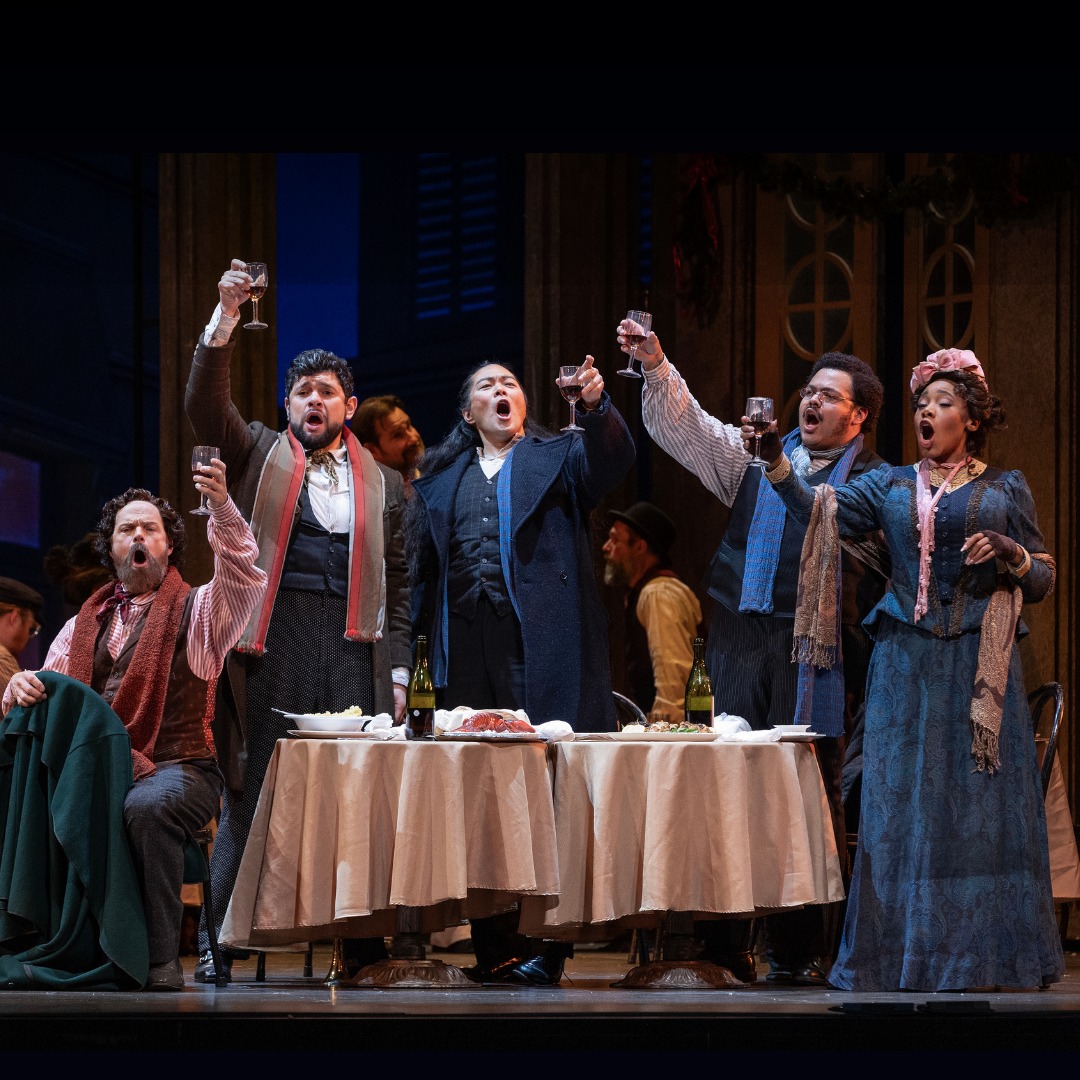
E_adj.jpg) nough periphasis, then. Austin Opera's La bohème was a gorgeous production. Three impressive sets (a garret, a street in the Latin Quarter, and an outdoor courtyard at night in the snow), convincing and wonderfully lit.
nough periphasis, then. Austin Opera's La bohème was a gorgeous production. Three impressive sets (a garret, a street in the Latin Quarter, and an outdoor courtyard at night in the snow), convincing and wonderfully lit.
Brittany Olivia Logan as Mimi and Jasmine Habersham as the tough party girl Musetta anchored the female spectrum, and Joshua Blue led his own gang of 4. Timothy Myers conducted Puccini's music with a sixty-piece orchestra, for a stage bursting with talent both international and local. Principals' voices were magnificent all—I'm incapable of establishing degrees of difference at that level of vocal achievement.
Austin native Eboni Adams deftly directed the bohemian garret scenes so the antics of the starving artists seemed to take place in a cramped space despite the vastness of the Dell Hall stage. And in Acts II and III in the lively Latin Quarter and the menacing torchlit Barrière de l'Enfer, she created a bustle of scenes of plausible, orchestrated movement from an enormous assembly. Austin, Texas furnished a chorus of 24; a youth chorus of 15; supernumeraries and a marching band totaling 12. As the curtain fell for the second intermission of this five-act opera, the audience began to rise, but the curtain soon went up again—giving an early curtain call for those approximately fifty local performers, costumed and grinning. After intermission it was back to garret and the gripping final scenes with the expiring Mimi.
This is what Austin Opera does. For La bohème they brought in at least a dozen top-quality professionals, performers and designers. Bios in the program documented achievements and performances from across the globe. With that astonishing artistic power, AO serves its audiences, Austin musicians and artists, its donors and philanthropists, and the city of Austin generally. That crowd of hired-in talent has now dispersed along national and international circuits, but they leave behind memories of artistic achievement.
As for slogans, you can forget elegant and inviting too. Like the city itself, Austin Opera has no need to mutter, "I coulda been a contender."
'Cause they are. They've arrived.
La Bohème
by Giacomo Puccini
Austin Opera
April 30 - May 03, 2026
April 30 - May 3, 2026
Dell Hall, Long Center, Austin
Tickets via www.austinopera.org