Recent Reviews
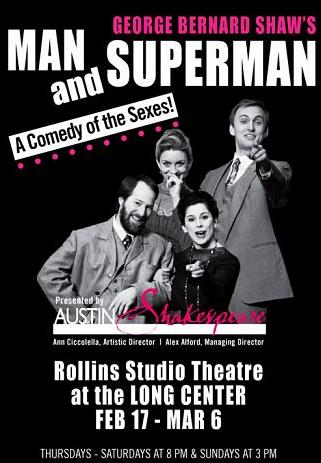
Review: Man and Superman
by Michael Meigs
Published on February 21, 2011
Austin Shakespeare gives us the law of the jungle as practised in the drawing rooms of London. Shaw's side dish of philosophy, heaven, hell and Don Juan will be served up separately.
Austin Shakespeare's staging of Shaw's Man and Superman at the Rollins Theatre has the pleasures of a long agreeable evening with toffee and cigars. No game of whist or bridge, for the contest here is between Man and Woman, or, to wax a bit more Shavian, between Man the Romantic and Intellectual on one hand and Woman the Life Force on the other. Man doesn't stand a chance, of course. You may well ponder -- …
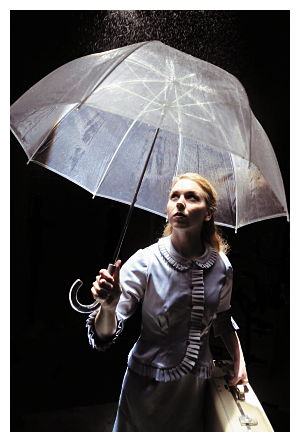
Review: Eurydice by Mary Moody Northen Theatre
by Michael Meigs
Published on February 10, 2011
The cast and production team produce Ruhl's sweet song of the end of life and time with elegant simplicity.
In Sarah Ruhl's world, stones can talk, the dead can send letters to the living, and the devil connives to send a fragile bride to her death so he can court her in the afterlife. On the far side of the river of forgetting, memory fades and the ability to read disappears. Young Orpheus, bereft in this life, telephones a long-distance information operator in an effort to try to locate his dead wife. Despite the …

Review: Art by 5 x 4 Production Company
by Michael Meigs
Published on February 09, 2011
The French, oh, the French -- I squirmed often while watching 5 x 2 Productions' staging of Yasmina Reza's Art, because she captures with deadly accuracy the most galling aspects of the Gallic character.
The French, oh, the French -- I squirmed often while watching 5 x 2 Productions' staging of Yasmina Reza's Art, because she captures with deadly accuracy the most galling aspects of the Gallic character. You may well laugh at the absurdities of the premise and the reactions of the characters. Serge, a dermatologist, is proud of the painting by a fashionable artist that he has just purchased for "two hundred thousand" -- those are 1995 …
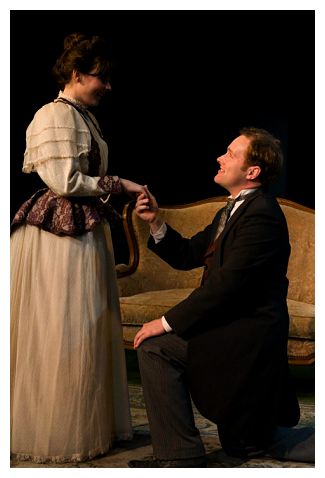
Review: The Importance of Being Earnest by Austin Playhouse
by Michael Meigs
Published on February 07, 2011
The faces are familiar, regulars all, and the only real surprise is Rick Roemer's enchantingly starchy and autocratic dignity as Lady Bracknell.
This "Trivial Comedy for Serious People" opened in 1895 and it was the last shining moment for Wilde's career as writer and dramatist. Soon afterwards he found himself in court, accused of immoral behavior and then sentenced to gaol. Because of that scandal the original production closed after only 86 performances. Since then it has become one of the most dependable and regularly revived comic satires on the boards. Wilde's earnest young men show themselves …
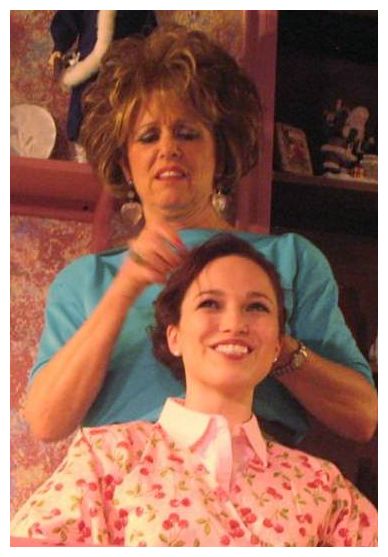
Review: Steel Magnolias by Sam Bass Community Theatre
by Michael Meigs
Published on February 03, 2011
Tickets for the Round Rock hometown production of this hometown comedy-drama are moving briskly. Everyone wants to go down to Truvy's. Even the good ol' boys.
At one point in Robert Harling's mischievous script for Steel Magnolias, set in Truvy's beauty shop in Chinquapin, Louisiana, newly hired perm-and-trim assistant Annelle worries that one of the husbands might intrude into that women's world. Tidily turned out Clairee Beltcher responds, "Oh, those men wouldn't ever come in here. They're afraid that we might be running around nekkid or something." Harling's 1987 play and the 1989 film of Steel Magnolias succeed exactly for that …

Review: Flying by Breaking String Theater
by Michael Meigs
Published on February 01, 2011
Mukhina, Schmidt and this talented company create a terrific, terrible and hypnotic spectacle for us. Flying is an experience not to be missed.
Olga Mukhina’s Flying is a fast, dangerous and exhilarating ride. Graham Schmidt and Breaking String Theatre put audiences up close to the beautiful youth of post-Soviet Russia in this 2004 piece. Olga Mukhin was one of those who originated the “New Drama” that came raging into Russia's mid-1990’s. Flying plays until February 19 at the Off Center, 2211-A Hidalgo Street (behind Joe’s Bakery on 7th Street). This is the North American premiere. Heedless, hedonistic and …