Review: The Visit by University of Texas Theatre & Dance
by Michael Meigs
Director Sunghyun Lim's ingenious staging of Dürrrenmatt's The Visit seizes upon the intimacy of cabaret styling and contradicts our expectations by visually expanding the story to the entirety of the virtually bare stage of the B. Iden Payne Theatre at UT Austin. Comedy in closeup-late-night-in-your-face-wink/wink style is all the more striking when performed in the vastness of that space. The spare presentation also contrasts with the mostly unseen resources available to bring it onstage: the cast of twenty is supported by 130 named crew members and twenty-two named advisors.
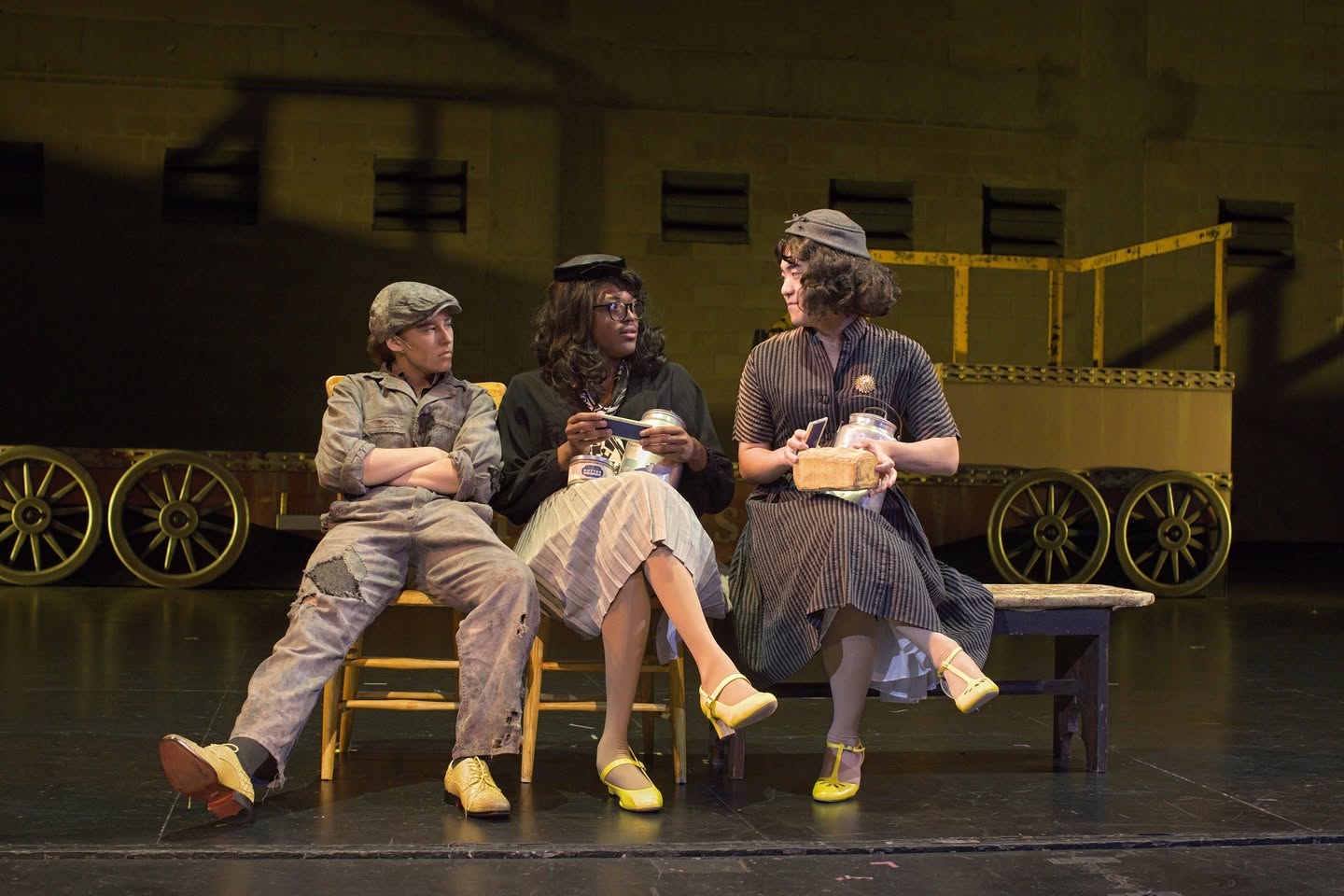 The first production of Das Besuch der alten Dame by Swiss German writer Friedrich Dürrenmatt was in Zürich in 1956. UT Theatre & Drama uses Maurice Valency's 1957 translation. The bitterly satirical tragicomedy has lost none of its bite in the intervening seventy years. Its hypothetical is fundamental: how much temptation would it take for a whole society to forsake its values and do the bidding of a deeply offended billlionaire?
People of the once affluent but now poverty stricken town of Güllen are thrilled to learn that the richest woman in the world is coming to visit them. She left their community at the age of seventeen but has never forgotten it. Visions of new investment, economic revival, and wild happiness flood their minds. They appoint local shopkeeper Anton Schill, her boyfriend at school, to romance the money out of her. Claire Zachanassian arrives on a long, stripped-down vehicle comically representing a railway carriage and promises to write a check for a billion, half for the town, the rest to be divided evenly among the inhabitants.
On one condition: she wants Anton Schill dead. She brought a coffin in her railway coach to cart him off once the deed is done.
Dürrenmatt and Lim push us to laugh at the absurdity of the townspeople, the situation, and the demand. Puppetry is used for some scenes. Characters frequenty deliver their speeches in the direction of the audience instead of to one another. Every character shown onstage is bouncy or funny or bizarre—except for the two leads.
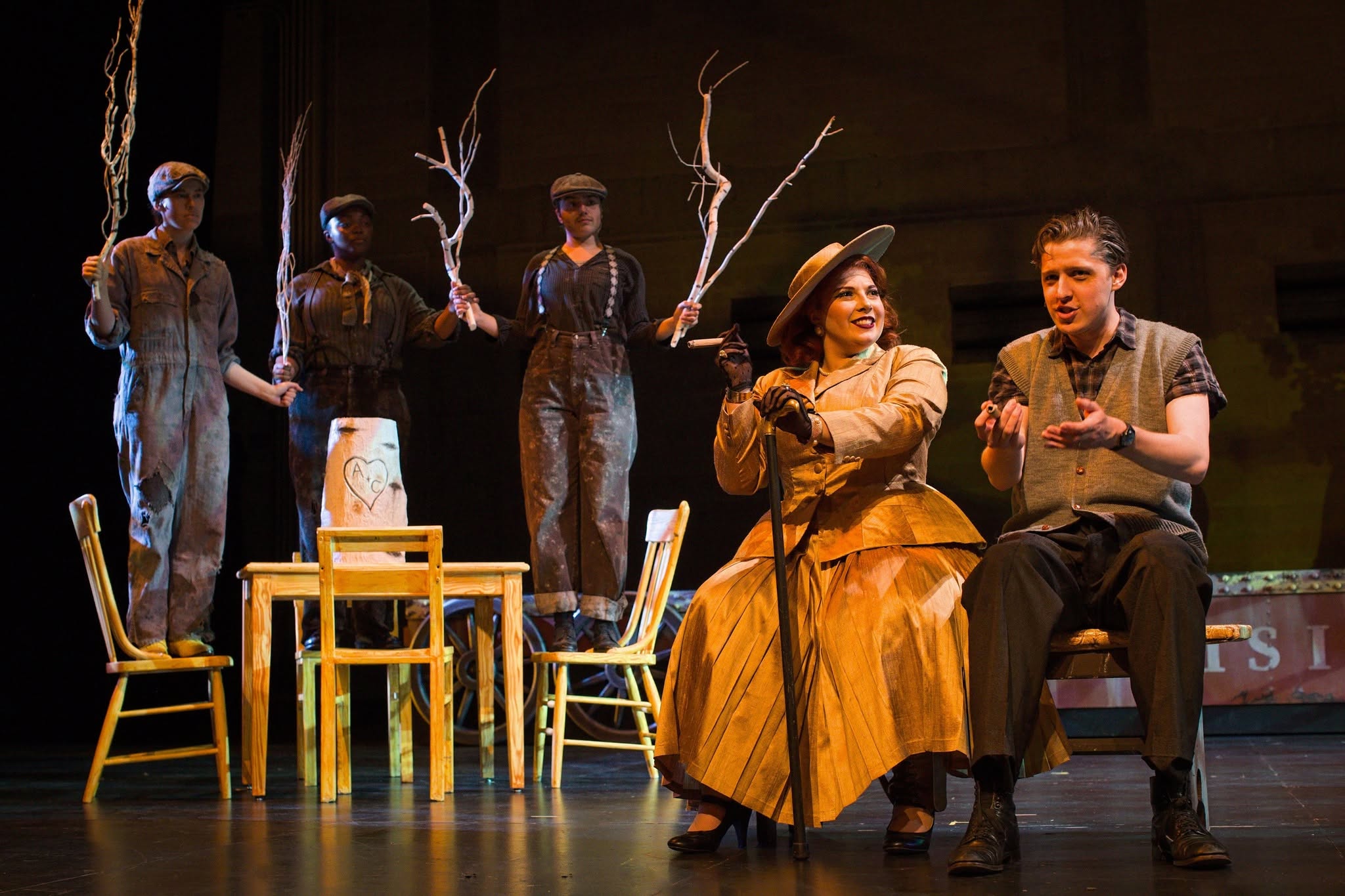
Emerson Hartman as Claire is self-possessed, charming, and matter-of-fact. She's no alte Dame either; with her voluminous chiffon and elaborate hats, her quiet command, and a deliberate gait due to a leg broken in a Himalayan plane crash, she's glamorous and believable. Connor Davis as Schill, who made her pregnant and bribed witnesses to escape responsibility, gives us a hard working, earnest villager who over the intervening decades has been a solid citizen and has raised a family. Well spoken and taller than most in the cast, Davis is entirely serious. He shades his performance carefully, graduating emotional reaction as Schill sees his community seduced by Claire's pledge to renew their lives. As the second half unwinds, Davis demonstrates not desperation but a stoicism that shades into unapologetic resignation.
The cast's dialogue and diction are exceptionaly distinct and crisp, amplified adroitly by sound design. Guilianna Coco as the cute fighting cock of a mayor is notable among them. As the schoolmastee, a custodian of moral values, Chiamaka Igwebu is equally clear until, unfortunately, he rushes and mangles lines when his character has turned to drink and can no longer articulate those values.
Act I takes place with no video, anchoring us in the town's disadvantage with the emptiness of that big stage. After that, video design amplifies action and provides commentary. On either side of the stage appear live video projections of Hartman as Claire contentedly waiting while the villagers gradually give in to temptation; as townspeople formally debate Claire's demand, the back wall of the performance space fills with stark sepia-colored images of a European village. Less effective is the depiction of talking head journalism. Not because the commentary is brain dead (that's to be expected), but because lighting is inadequate and images wildly jumpy, detracting from stage action as they're projected behind it.
Strikingly effective are the images taken from directly overhead after Schill's sentence is pronounced. He stands alone. A single muscular villager approaches and wraps arms around Schill in what could be affectionate embrace. One by one, the others join that group until we witness an amorphous huddle, a collective in which all inhabitants have joined, rending it impossible to identify any single person responsible for the outcome.
For a work by a Swiss German writer staged only a decade after German surrender, that message was powerful. It is equally powerful although with different implications as the United States approaches electionos.
A bit of dialogue coaching would have mended some minor flaws, such as the pronunciation of the town name (there's an Umlaut in it) and correct French pronunciation of "adieu" and "Geneviève."
The Visit
by Friedrich Dürrenmatt, trans. Maurice Valency
University of Texas Theatre & Dance
October 29 - November 8, 2026
B. Iden Payne Theatre, University of Texas at Austin
Tickets on sale August 3, 2026