Austin Creative Reuse’s Reuse on the Runway: A Night of Fashion, Cosplay & Drag
The fifth edition of Austin Creative Reuse’s Reuse on the Runway is happening this Saturday, and you don’t want to miss it. Described as a “Night of Fashion, Costume and Drag” this event is so much more than a mere fashion show. It includes local creators and makers prepared to show more than fifty unique designs created in part with reused materials. Additional activities include a photo booth, a live DJ, a full bar, a food truck, baked goods, and crafting stations. On top of that, their Close Up on the Couture will allow the audience to meet the designers and models after the show.
Austin Creative Reuse has not been working quietly behind the scenes since it began organizing in 2009, to the contrary they’ve been expanding their impact every year while promoting its central tenet of fostering “conservation and reuse through creativity, education, and community building.” ACR currently reports diverting more than 3.5 million pounds of usable creative materials from the landfill, with a diversion rate above 97%.
It began as a collaboration of artists, educators, and environmentalists which became a nonprofit in 2011. They opened their first creative reuse center in 2015, which is not to be confused with a mere thrift store. In addition, to the unique items found for sale the center provides classes, workshops, community volunteers sessions, craft activities, reuse art markets, demonstrations, educational programming, field trips for students of all ages, and many ways to support teachers and schools by gifting them reclaimed school and art supplies, which they also recover themselves. It’s not just someplace you can drop off your Marie Kondo-ed items.
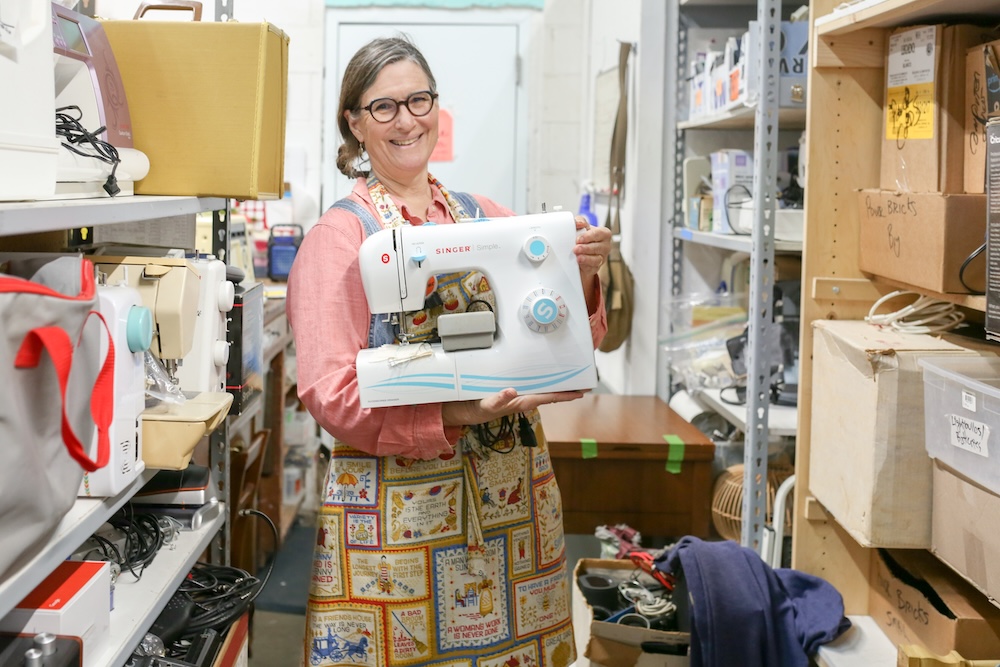
I sat down with Austin Creative Reuse’s Carole LeClair to learn more of the story. LeClair has been involved with ACR for nearly two decades and was honored by recognizegood.org for her staggering 9,500+ hours of volunteer service. She joined the board in 2014 and is the current Board President. She was integral to the creation of ACR’s permanent location. Unsurprisingly, she is also a crafter, up-cycler and sewing enthusiast. In fact, when I spoke to her, she was on a brief break from testing sewing machines and saving them from the landfill. All quotes below are from her
On Austin Creative Reuse Center-
“We have this beautiful retail space here, but we don't call it a store. We call it a center, because it's more about the other things that can also happen here.”
“We're impacting the people who donate to us as well. They are thinking differently because they're not going to throw that stuff away. You have to bring it to us by appointment—you don't just drop it off like at Goodwill.”
“We have hundreds of volunteers who come here every week. Over 40% of our materials are processed by volunteers. We're really impacting the way those folks think about the things in their lives. And so, in the end, if we get people to more consciously consume, to think ‘I don't need a hundred of those things. I just need one of these things. Maybe I don't have to buy it off Amazon. I can go to ACR and get those things that I need.’ You'll come here and you'll find those things, and we very carefully curate and sort and make sure to bring the value back into those materials that are so often thrown away.”
“Our goal is 34,000 pounds a month, but we easily top that most months. And then we have other programs, like Reuse on the Runway.”
On the School Programs -
“We have our educator programs, which are where we take materials directly to schools and let teachers take the things that they need at no cost to them. We're literally bringing the materials to them and letting them choose. We're hoping we're impacting the way people think about materials, showing people that these things have value. Composition books that have three pages written in and a name written on the front—that composition book still has value, and it does not have to go to landfill.”
On Art Markets -
“We have our art markets twice a year. They're two weekends right after Thanksgiving and then two weekends in the spring. They are hugely attended, and the booths are very low cost compared to a lot of the other art market booths. So, ours, it's very easy to enter. I'm always so delighted that we try and make space for new vendors, people who have never sold at a market before, and give them a place to show their things.”
“That's another way that hopefully when people go to these art markets and they see they're buying art that is made from reuse materials—that they think differently about those corks and those bottle caps and those things in their lives. Like, ‘Oh, is this potentially a creative material for me?’"
On Reuse on the Runway -
“When we first started, it was a free event just to bring the community together. It was very handmade, homemade, what we could figure out at the time. And it just has proved to be such a popular event that we have just put more time, effort, and money into the event to try and make it a cultural event for the city. People love the creativity of it, thinking about materials in a different way. So, it's really grown from there. We sell out every year. We know there's a demand.”
“We try not to turn anyone away, though we do vet their submissions to make sure that there are reuse elements to it. This year almost everyone who applied is going to be bringing at least one outfit, so we're going to have a lot more a lot more looks. We had fifty last year, it is going to be more like seventy this year. We are seeing both the same designers coming back and new designers are coming in to be part of the show. I would say most of the vast majority are not professional. This is way for people to step outside their creative world and design a couture look versus doing something that's more classically art focused.”
“This is not a fundraiser for us, believe it or not. As much work as we put into this, we break even. So, it's very much a homegrown, homemade, gift from Austin Creative Reuse to our community to come together for a night and just celebrate reuse. An event like this, if you go to it, you'll see it's extremely professional. And so, it's expensive to put on. We have some corporate sponsors, which is great. There are a lot of businesses that we work with regularly, will give us some money to help us offset the cost of the event. We also have been receiving grants from the city, cultural arts grants. But like I said, it's really a community event for us. We want people to think ‘maybe there's something creative I can do with that material that I have in my life. Maybe it could be part of my creative process?’ Many of these designers come up with these amazing looks that are made with plastic bottles or straws or silk ties, and pop tabs off of aluminum cans.”
On the Closeup on Couture-
“It is a high-energy show. People definitely stick around to see the looks and talk to the designers and see what they're doing. Some of the materials are very tactile. And so, people definitely want to go up and touch them and see what they're actually made of, because the looks can be very deceptive. It's like it's made out of plastic bottles, but you would not recognize it as plastic bottles from afar.”
On the Future-
“I like to tell people we're not an arts organization, we're not an education organization, we are a conservation organization at our heart. That is what we do. We're feeling like people are discovering us all of the time. We regularly consult with people who are interested in starting creative reuse centers, to try and spread the word. I wish every city had a creative reuse center, because I think just spreading that kind of message around could really impact, hopefully, how people think, "Oh, maybe I don't need so much stuff."