Review: Austin Dance Festival by Kathy Dunn Hamrick Dance Company
by David Glen Robinson
 The Austin Dance Festival 2026 was the latest success in a long line of such. This eleventh edition was in honor of founder Kathy Dunn Hamrick, who died in February.
As traditionally structured, the event consisted of workshops, masterclasses, video interviews, academy showcases, and professional company showcases. The curated professional showcases are by application and invitation. This review examines the eighteen works in the 5 pm and the 8 pm shows. Given that number of dance works, in a review of reasonable length the reviewer can provide no more than thumbnail assessments.
The festival offered a surprise in the reception between the showcases: a pop-up dance choreographed by Carol Lewis, using 1950's crooner Bobby Darin’s Beyond the Sea, sung live by singer and raconteur John McElhenney.
The Dance on Film show, which took place in February this year in a different venue, is an allied branch of the festival.
5:00 p.m. Showcase
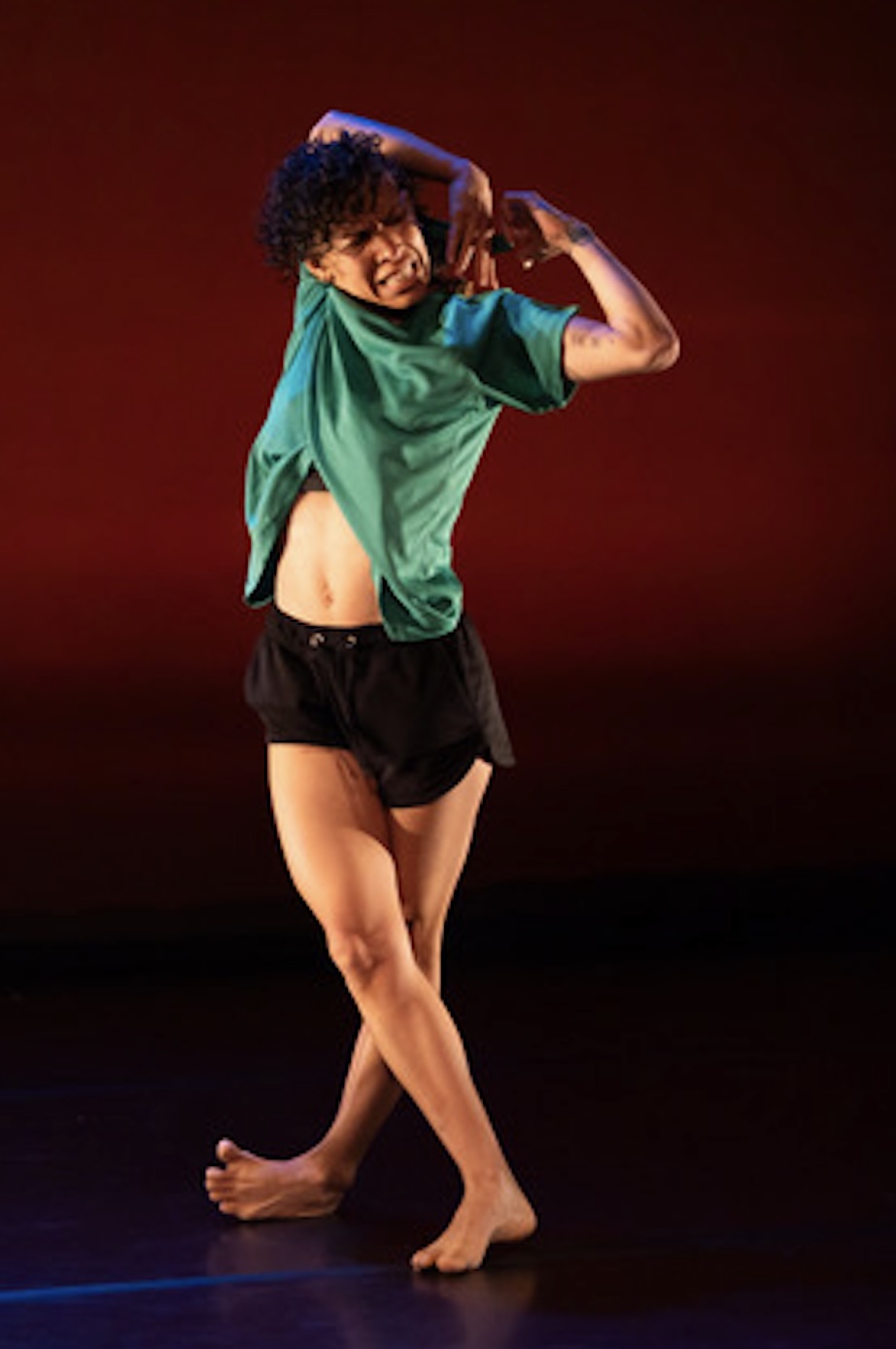
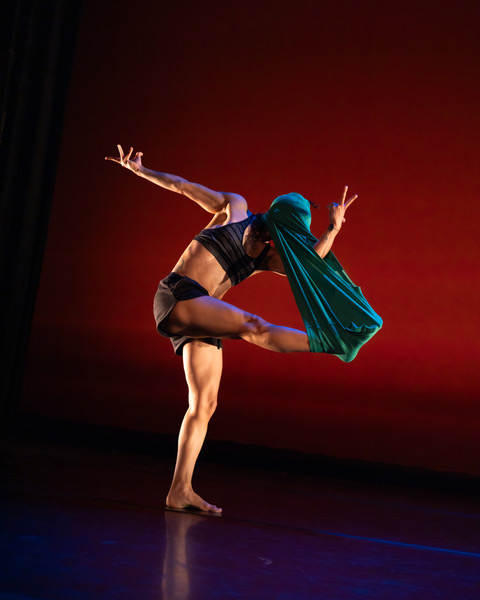
“0.4mm” by Evelyn Tejeda. The solo danced by Tejeda, gave us a showcase of athleticism and flexibility. She tied herself into and out of a large green t-shirt, demonstrating imagination and cleverness. She may have been making symbolic statements while keeping a persistent frown on her face—but as with all abstract movement, the narrative behind the symbols was difficult to grasp, if indeed there was one. The piece was enjoyable as a demonstration of technique. One notes that 0.4 mm is one of the standard ink pen barrel widths in graphic art. Significance? Unknown to the audience.
“Sloppy Janes (Slippety SLOOP)” by RushTopFish. The piece was a fast change of pace from Tejeda’s dance. Dancers Emily Rushing, Lisa Shreck, and Tikiri Shapiro gave us a series of comedy tableaux, The dancers played food trash, their movements sometimes verging on pantomime, to a soundtrack of slurping and squishy noises. The dance relied on floorwork. Costumes were baggy shirts and slacks with paint splashes and drops all over them, and they looked like uncleaned dinner plates. Carissa Topham Fisher and Emily Rushing were responsible for the choreography.
“Play the Hand You’re Dealt” by Camicollabs LLC. Choreographer Cami Holman danced a sequence of dropping and throwing large sets of playing cards both one by one and in groups around the stage, forming some patterns and disrupting others. Actual dance gestures and movements looked to be restricted to accents and points of emphasis. The music and sound effects seemed more relevant to the meanings and imagery of the piece; there were four credited musical pieces, all arranged in studio by Cami Holman to form the soundtrack.
“Threads of Emergence” by Hannah Joy Mettler. Choreographer Mettler brought her company and exquisite contemporary dance from Houston. They gave the audience duet couplings and trios and larger ensemble passages. Edges and forms were precise and well executed, and the unison work in ensemble was perfect. It was an honor to receive such a perfected and well finished stage dance. The dancers were Dillon Bell, Cole Hinson, Bronte Hopkins, Camila Maldonado, Hannah Joy Mettler, Carly Ross, Olivia Salazar, and Andrew Robert Smith.
“Masculus” by Spaces of Fontana. The dance was a duet by two men, Matthew Sommers and Connor Timpe, dressed in office-casual neat attire. Timpe appeared alone, downstage right, making small movements. Sommers entered stage left, and the two men began a high technique duet, trading lifts and shapes that looked like nothing less than grappling. They performed skillfully and used much of the stage space. The piece ended with a voiceover poem by Lucas Jones and Sommers alone on stage making the same small movements with which Timpe had begun the piece. That established the performance as a mirror dance, on themes of conflict and resolution. Many in the audience found Evelyn Joy Hoelscher's gemlike choreography to be the best in the program. All look forward to more work by Hoelscher, the company's artistic director. The company is a relative newcomer to Austin.
“Air” part 3 of “I’ll wait here until you call my name.” by Lisa Nicks and her Band of Wild Ponies. A solo danced by ballet dancer Taryn Lavery, the dance had an air of historical continuity throughher spectacular, flowing orange and red costume. The garment was constructed by dancer Amy Burrell several years ago for apiece by choreographer Lisa Nicks. The updated dance and use of rthe costume in a dance employing perfected technique was an excellent choice and aworthy contribution to ADF.
“Trios En Un” by Lydia McDonald. The dance was a trio in flowing, warm-colored costumes. It could have been seen as an even more enjoyable extension of the previous dance. The similarities set off differing choreographic choices, however, especially in shapes held by motionless dancers while others made duets and athletic phrases. Specifically, while sitting on the floor with knees up and legs apart at 45o, the dancers created forests of mountain shapes or M-shapes. These, vaguely erotic, were reference bases not seen in any other dances in the show. They served as launching pads to the diverse and smooth passages and phrases showcased in Lydia McDonald’s abundant choreography. The dance was rich and satisfying. McDonald and dancers Stephanie Mizrahi and Mizuki Sako hail from Los Angeles; this is their second journey to ADF.
“Unprocessed” by Timothy Amirault. Amirault performed his choreography in a solo focused on the long diagonal from upstage right to downstage left on the wide Ventures Studio stage. Amirault’s tall figure, performing priincipally upper body gestures, easily commanded the entire stage. His costume, designed by himself, was medium gray fabrics apparently adorned with chains and cables hung with metal bits and appurtenances, giving the performance a BDSM mystique. That and his classical-operatic soundtrack made his piece the most distinctive and mysterious performance in the show.
“Punchy” (an excerpt) by KDH Dance Company. Choreography by Alyson Dolan with the company. The dance excerpt was a model of varying energy levels, from hardly discernible micro-movements to wild, reaching runs across the stage. The well-trained company did all of this was in perfect timing, one of several legacies of Kathy Dunn Hamrick. The dancers were Anna Bauer, Celeste Camfield, Jairus Carr, Cara Cook, Lisa del Rosario, and Love Muwwakkil Estes. The original soundtrack by Drew Silverman was reprised for the soundtrack. His musicians were Henna Chou, Leila Louise Henley, and Andy Nolte in addition to Silverman.
8:00 pm showcase
“Casual Malice” by Social Movement Contemporary Dance Theater. Choreography was by Abby Williams Chin. Her work was set on her Houston-based company comprised of Jordan Dozier, Alyssa Foglia, Rachael Hutto, Allyson Ruble, Raegan Noelle Taylor, and Yu-Ling Yeh. They showed excellent technique in their large ensemble dance. They also offered a surprise in giving direct vocal responses late in the dance.
“Bound” by Ty&Co. This was a duet by two perfectly matched, athletic dancers. Ty Graynor and Meggie Belisle both transcend their complex technique to feel and express passion, love, contradiction, sorrow, and all that flows like a river through intimacy. We were honored witnesses to this treasure of a duet.
“Wish You Were Here” by Monica Bill Barnes. Annika Shaeff brought this solo to ADF and performed it. The whole thing was a major surprise. Shaeff was dressed in a peachy/orange coverall. The dance started as a standard modern dance solo and quickly turned into a story dance with some pantomime—taking place in a dance club. Shaeff shifted characters moment to moment, inviting connection from one direction and refusing it from another direction, etc. She even switched into the characters of her suitors, forming a whole line-up of cartoon characters by the end of the dance. Excellent.
“Enlace” (excerpt) by Jordan Fuchs Dance Company. Choreography was by Jordan Fuchs and the dancers. The company from Texas Women’s University in Denton danced in the ensemble in mixed costumes to Brittany Padilla's original music composition. Their near-perfect performance showed great potential. The dancers were Annalise Boydston, Daniel Garcia, Whitney Geldon, Emeralda Ledesma, Asiyah Martin, Krysta Ortiz, and Kiara Taylor.
“Three to Tango” by Ventana Ballet. The choreography was by A.J. Garcia-Rameau. The dance was a trio to tango music danced in contemporary ballet movement and tango costumes. The technique was perfect. The overall intent was hilarious comedy, and it succeeded. Prima ballerina Garcia-Rameau danced between two men (Aidan DeWitt and John Henry Reid) who danced in competition for her favors, coming forward in pride, falling back in shame, growing in anger toward the rival. Garcia-Rameau smiled and danced, reveling in the jealousy.
“This Version of You” by Kaley Pruitt Dance. Rachel Greene and Patrick Marquice Ingram performed Kaley Pruitt's choreography. The technical performance was adequate, but it was not well served by the baggy, neutral costumes. The intent and point of the dance seemed to lie with the lyrics and various inflections and iterations of the phrase “this version of you.” The extended tight hug as the lights faded down was a cliché.
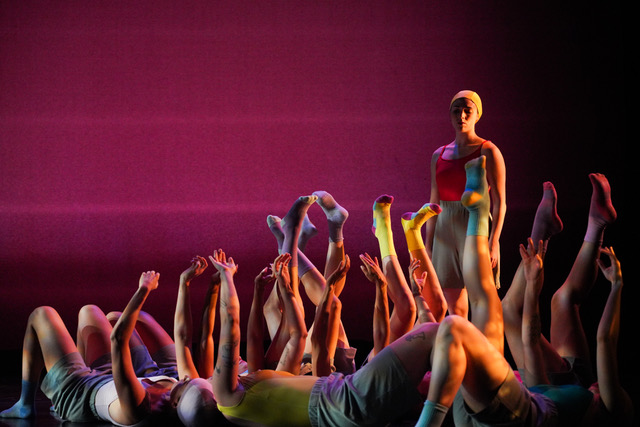
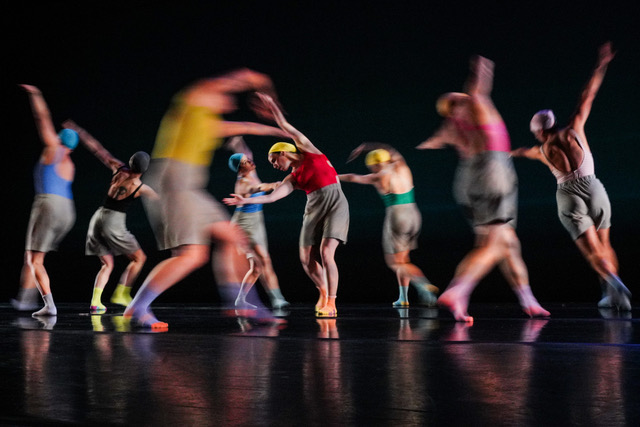
“Poems Pondering Pools” by Alexa Capareda. The piece was a monumental performance by ten dancers costumed in bright mis-matched pool gear including rubber pool caps common in the 1950s. The dance was contemporary but featured phrases and tableaux reminiscent of movie scenes of Esther Williams performances. The soundtrack was partially music made with water sounds produced by rhythmic splashings and swirling (essentially percussion with water) by traditional tribespeople in the Philippines and West Africa. The stage-filling dance was satisfying, innovative and unique, laced with Capareda’s signature tongue-in-cheek humor. The dancers were Venese Alcantar, Cellise Brown, Celeste Camfield, Taryn Lavery, Jordan Miller, Sarah Annie Navarrete, Melissa Sanderson, Lisa Schreck, TeeDee Simons, and Camille Wiltz.
“Cut From Compliance” by Jennifer Williams. The piece was a well-performed athletic duet by Sonja Dangler and Natasha Small, the MC of the showcases. They were costumed in office formal, men’s dark suits and ties. Almost like condensed episodes of “The Office,” the dance gave us everything that can go wrong in that setting, all in modern dance phrases and inflection. The piece ended in a line-up of abstracted repetitive work, moving pieces of paper place to place as the light faded down.
The showcase ended with a reprise of Evelyn Tejeda’s “0.4 mm.” That high note ended the 2026 Austin Dance Festival, except for artists’ interviews with Kate Warren the following Sunday morning at Café Dance.
Austin Dance Festival 2026
Produced by KDH Dance
April 9-12, 2026
Austin Ventures Studio, Ballet Austin, downtown Austin
Austin Dance Festival
by various companies and artists
Kathy Dunn Hamrick Dance Company
May 29, 2021
Annual festival held May 29, 2021 at Pioneer Farms, Austin.