Recent Reviews

Review: Seamstress by FronteraFest
by Michael Meigs
Published on January 29, 2010
Melanie Dean is charming and reassuring, as she's fretting with notions both visible and invisible. Fussing about the shop ,she chats to the spectators, stand-ins for the apparently silent client.
Is it ethical for a theatre journalist to accept a cookie from an actress in mid-performance?How about if everyone in the audience has a chance at the home baked goods, because Melanie Dean has handed front-row spectators two big plastic bowls filled with cookies?There were lots left when the bowl came along the third row. I dipped in without compunction, happy to trust in Melanie's persona as the garrulous small-town Texas widow who has been …
Review: Dying City by Capital T Theatre
by Michael Meigs
Published on January 27, 2010
The back-and-forth of tense familiarity between Kelly and her brother Peter at times suggests a psychological ambush, at times a genuine reunion, and at times a therapy session.
Emptiness echoes from our first moments with Dying City.Motionless on the sofa, Liz Fisher as Kelly sits listening vacantly to Stephen Colbert's bright, acerbic chatter. She fingers a book; shifts her position; pushes at the stack of papers on the coffee table. An open cardboard box on the floor suggests packing or at least some interrupted task of organization. The buzzer sounds. Someone is downstairs and wants to come up. Dying City is not about …

Review: Lady M by Texas State University
by Michael Meigs
Published on January 26, 2010
Smith-Rodriguez's Lady M is a serious and respectful piece, providing a credible back story. Recorded Scottish history was no great help, as the playwright notes in the program.
With the imagining of her piece Lady M Melissa Smith-Rodriguez explores the darkness of pre-history, of feudal Scots customs and of the perceived enigma of character of the leading woman in Shakespeare's Macbeth. This play is not an exculpation of Macbeth's unnamed lady but rather the creation of a fictional history explaining the woman's cold, fierce and ambitious nature.As a mantra and foreshadowing the playwright evokes the dark night of Act II, Scene 2 with …
Review: Love Me
by Michael Meigs
Published on January 25, 2010
This is a courageous dish to set before an Austin audience. To some it might seem suspiciously erudite and obscure. Others will scoff at the emotion and vulnerability that constitute the principal elements of the action.
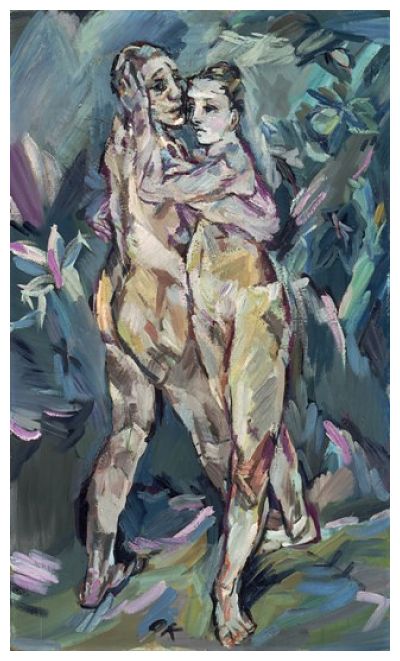
The title of Philip Kreyche's Love Me is deceptively simple. As playwright and principal actor he takes on German expressionism, focusing on the Austrian painter Oskar Kokoschka in the period 1918-1919, when the painter was known among his circle of bohemians in Dresden simply as "mad Kokoschka."Renowned as an artist of dark and powerful brushwork and a writer of equally dark, sex-obsessed essays and narratives, in 1912 Kokoshka became involved with Alma Mahler, whose husband …
Review: Moving' Melvin Brown by FronteraFest
by Michael Meigs
Published on January 24, 2010
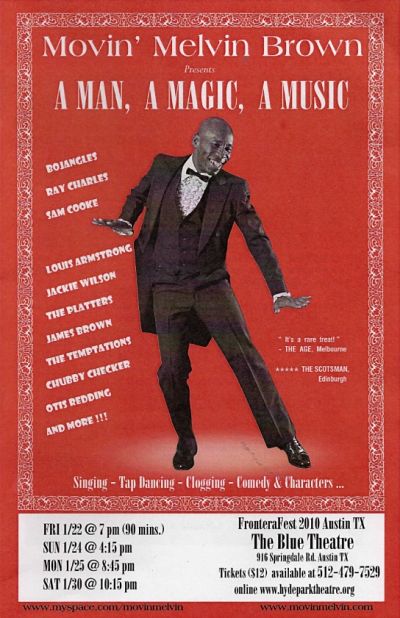
We clapped along, we swayed, we shouted and applauded. Movin' Melvin will tell you the story of his life and give you a "highlights" show that will leave you wanting more.
Melvin Brown is a big, serene tornado, a walkin', talkin', singin' and tap dancin' history of rhythm and blues, soul and entertainment. He comes from Cincinnati but traveled all over the country and abroad on the entertainment circuits, then settled near Austin after a long and eventful career. This man has a vital energy and irrepressible joy in life. He's 65 years old but he is strong, fast, funny and attractive. He's got a fine …
Review: Hotel Morocco by Echo Productions
by Michael Meigs
Published on January 24, 2010
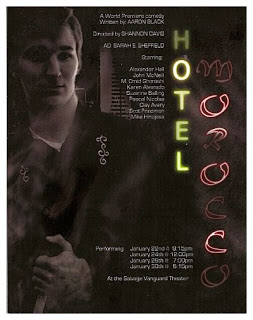
The story, such as it is, features Adam's increasing disillusionment and his reluctant relationship with Rocco the messy, stinking old Alzheimer's patient stubbornly holding onto his one-room residential lease.
Aaron Black's Hotel Morocco has lots of ambiance and some tough, snarling dialogue. Talk about atmosphere -- he has taken the 50s noir setting of a New York fleabag hotel, populated it with dumbasses, women looking for bad sex, gangsters, a demented ancient resident and one would-be writer on his way down. The writer, carrying the Everyman label of Adam, lost his previous job in a better hotel and is in deep, limp depression over …