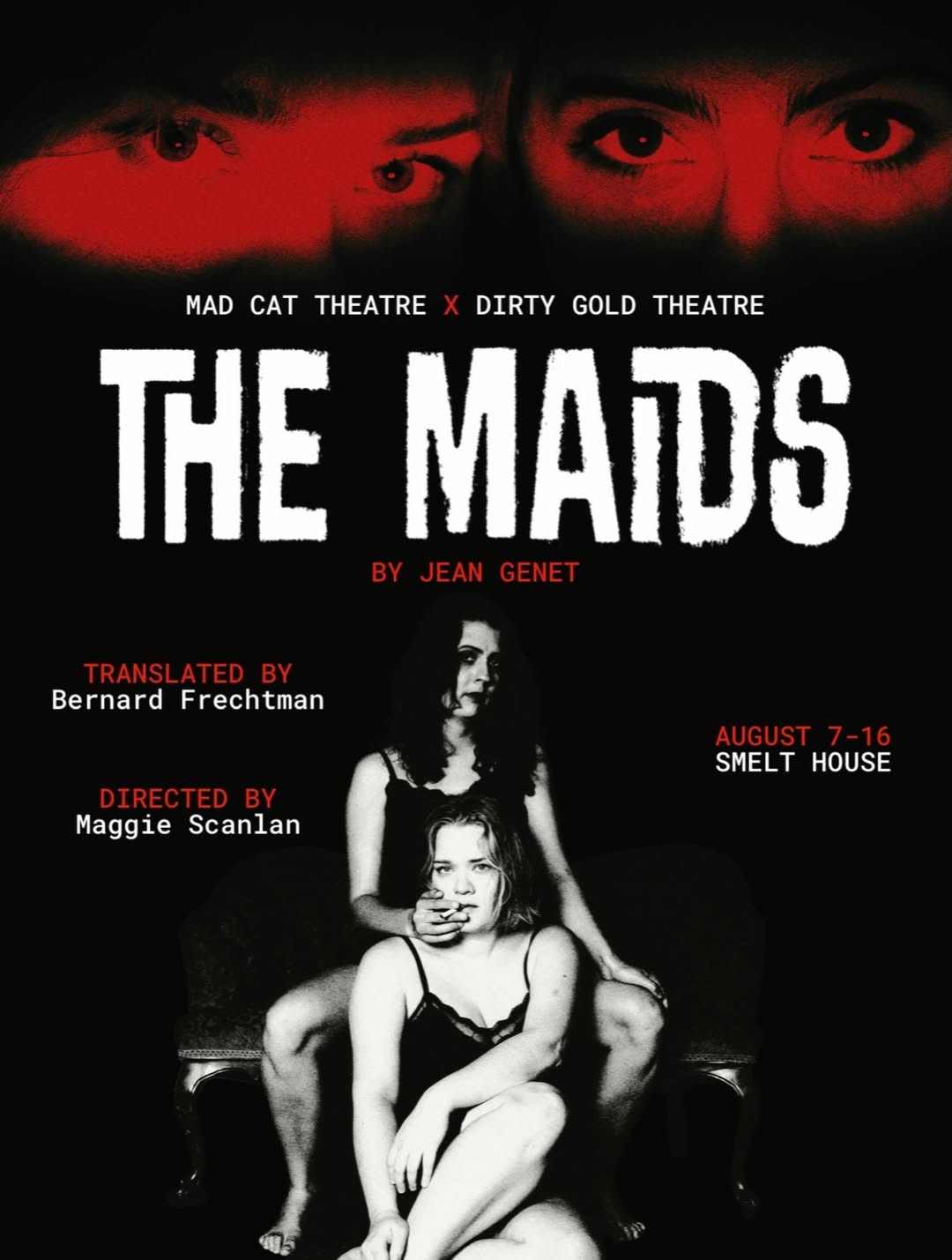
Review #2 of 2: The Maids by Mad Cat Theatre
by Brian Paul Scipione
Personally, I am not a fan of true crime. Still, in the pursuit of authenticity be forewarned that this article includes some disturbing elements. Also, it will contain spoilers for this 79-year-old play, Mad Cat's first production, which closed in mid-August.
J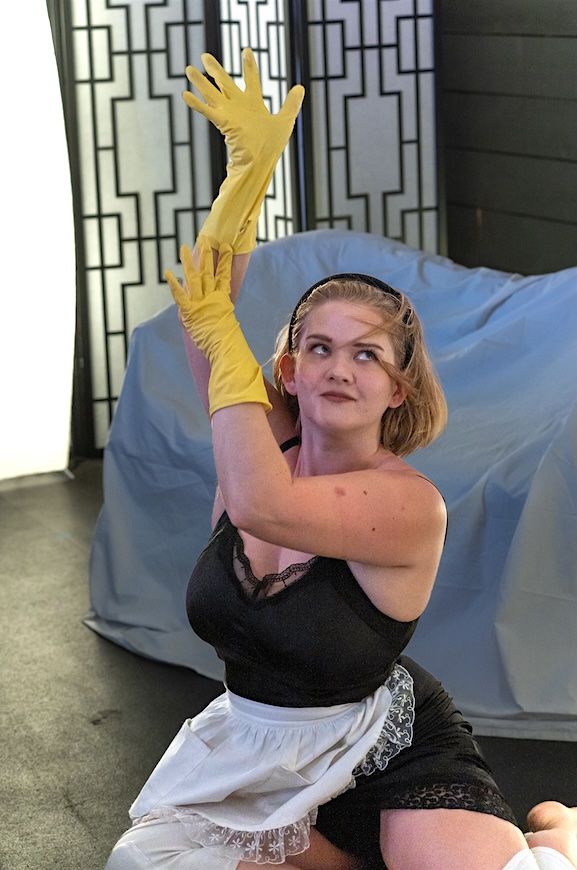 ean Genet's tale fictionalizes two sisters, live-in housekeepers convicted of murdering their employer's wife and daughter. Christine was the first employed but in a short time soon convinced them to hire her sister Leá. It’s been said that the sisters were very dedicated and worked many long hours.
The mistress of the household grew increasingly depressed and found it nearly impossible to oversee household operations. She kept no diary, so we can only surmise why she acted as she did. Even if we had Madame's diary, she'd almost certainly be considered an unreliable narrator.
Madame lost touch with reality, blamed her maids, and attacked them psychologically, physically, and emotionally. Some claimed she would even slam their heads against the walls. One night in February, after an instance of physical abuse, the sisters lost it and retaliated. The details grow ever more murky, but there's evidence suggesting that the bodies of the Madame and her daughter were grotesquely mutilated with various household implements. In a terrifying twist, the monsieur came home that night to a darkened house, assumed nothing was amiss, and ventured out to to meet his family at a dinner party where they didn't appear. He returned home to find himself locked out. The police were summoned, broke into the home, and discovered two dead bodies and the two naked sisters huddling together on their bed. One of the murder weapons, bloody and bearing traces of hair, was set on a nearby stool. The year was 1933.
Jean Genet based the play on this true story.
Genet’s play ends there. Following events, including the accused’s trial and their imprisonment, are simultaneously intriguing and shrouded in mystery. Elements of incest, self-abuse, self-defense, capital punishment, life imprisonment, and temporary insanity abound. The term folie à deux, a recently re-popularized expression meaning "shared paranoid disorder," plays a large role. Some readers may have already picked up on the story’s similarities to Parasite by Bon Joon Ho, awarded 2024 Academy Award for Best Picture . He does indeed cite this play as one of his three primary sources of inspiration.
Trust me, I really am attempting to end this review’s exposition, but there are a few more mentionable moments worth, well, . . . mentioning. The jury and judge considered the age difference between the sisters to a significant factor. One was sentenced to death, the other to ten years in prison. (Note: if you're a fan of French author Louis-Ferdinand Céline, who published his famous Journey to the End of the Night a year before the trial, you may question which sister’s fate was worse).
Both initially claimed sole responsibility for the crime, each seeking to protect the other. In prison they were isolated and kept apart. This separation caused the older sister, Christine, so much distress that according to some reports, she turned to self-mutilation. This may or may not be true, but the records do indicate she managed to starve herself to death over the next four years. Leá got out of prison early, thanks to good behavior, and then found a job. As a maid.
There are twenty-six different versions of the story of the Papin sisters, including the forementioned Parasite. Before seeing Mad Cat's version, my favorite was Claude Chabrol’s 1995 film La Cérémonie, which removes the implication of incest by making the story about a maid and a local postal worker. The other works include nine films, eight books, three plays, two essays, one painting, one chamber opera, one TV episode, one song, and one full-length opera. And Genet’s The Maids (Les Bonnes) has been performed regularly in many cities and countries since its 1947 debut.
Interesting side note: Genet claimed his play was not based on the Papin sisters. Genet was certainly more focused on the social class dynamics in post-revolution capitalist France. Like many of the artists who followed him, he seemed thrilled by a criminal who reveled in their crime. This concept was in vogue when he wrote the piece. And long has been—Shakespeare used it with many of his characters. Most notably Iago and Richard III.
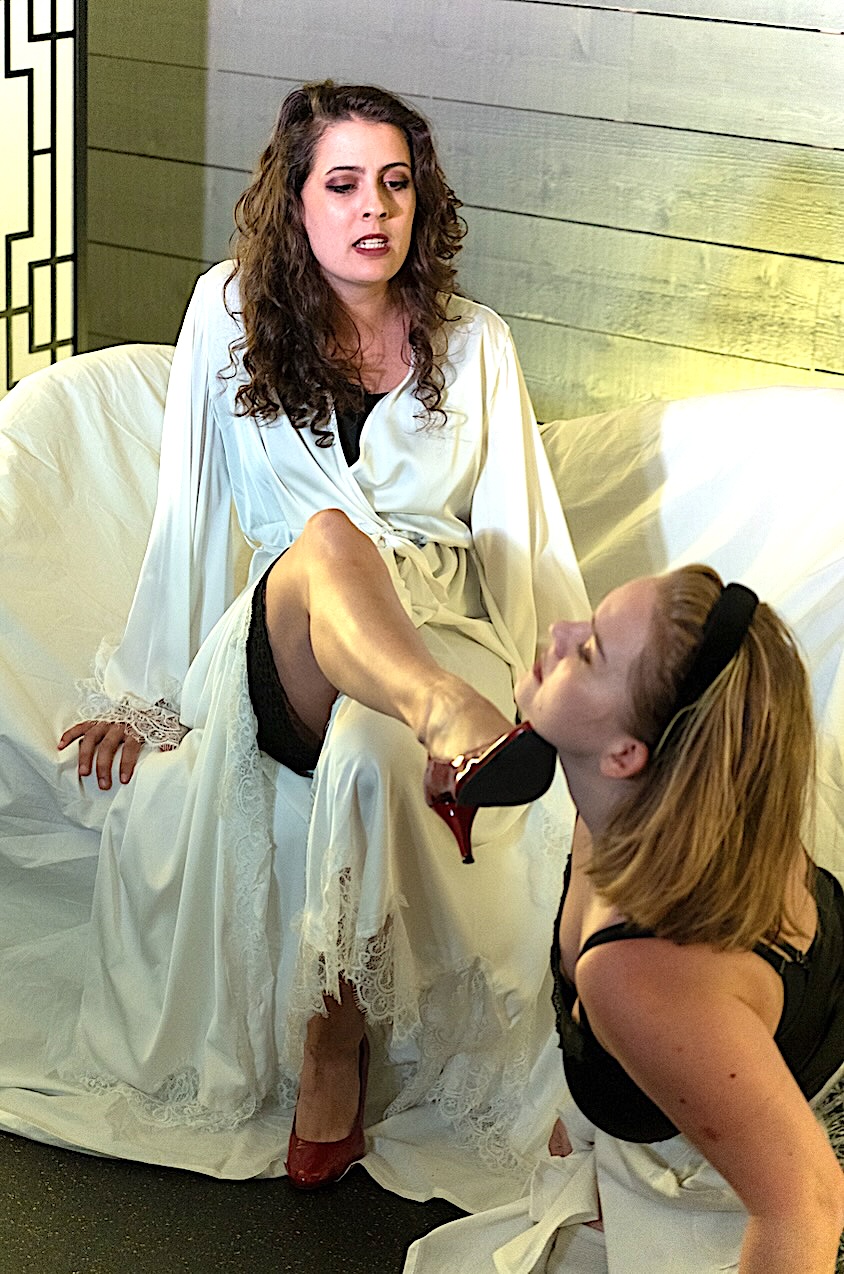
Genet’s assertion is simple: the maids represent the oppressed underclass with no way to lash out at their lot in life other than to attack their immediate rulers. For household servants this was made all the more intimate because they lived in the same home with the employers, ate the same food, shared the same romantic problems, stared out the same windows. They were housemates, roommates to a certain extent. They were quasi family. Friends. Yet they were never equal. When the oppressed lash out, they cannot attack the system. History, culture, politics, and religion are indifferent to their lot; the oppressed can attack only who those physically and emotionally near to them.
The story of The Maids is still relevant, and it was bold of Mad Cat Theatre to take it on as their premier production. Performances took place at the Smelt House, a small venue on the East Side. It's called a black box theatre but is more accurately described as a black shoebox theatre. This is not a dig, for the choice of venue was integral to director Maggie Scanlan’s vision. The performance was raw and intimate, and that's an understatement. The actors were so close to the front row that the audience breathed in the air they'd just breathed out. This production was sensational in every meaning of the word: dramatically exciting, deliberately shocking, impressive, outstanding, even related to the physical sensations and the senses. It was exactly the visceral and emotional theatre that Austin needs.
The cast included Angeline Castillo as Madame, Allison Paranka as Claire, and Maddie Scanlan as Solange. The action took place entirely in one room. The characters dueled with one another, first in role play and then in reality. The sisters had clearly played this game before: one of them played Madame, their mistress, and the other was the subservient maid. They made it abundantly clear that the employer-employee relationship was abusive on many levels. Scanlan and Paranka masterfully portrayed shifts in emotion and authority that changed faster than a butterfly beats its wings. It was engrossing, seductive, and unsavory at the same time. As if T.S. Eliot’s 1918 poem "Whispers of Immortality" had come to life. To paraphrase Eliot, the maids circumambulated around the stage like a jaguar stalking a marmoset.
There wasn’t a single instance of overacting or pantomime. The proximity to the audience did nothing to disturb the fourth wall, turning the audience into voyeurs complicit in the spectacle. When Scanlan and Paranka’s characters shifted roles in their pretending, their animal-like movements mirrored the story. Imagine watching a cobra face off with a mongoose, then seeing the mongoose become the cobra.
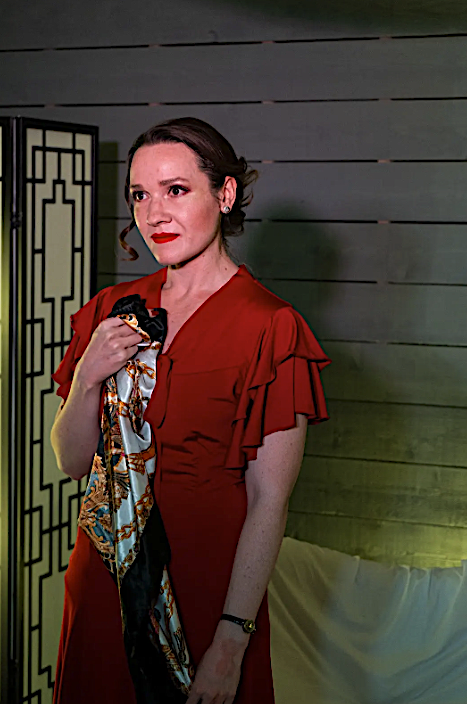 Entering the scene as Madame, Castillo she brought to mind a bird of prey. She repeatedly shifted with balletic elegance from utter stillness to abrupt motion. What began as two young women playing a game mocking their boss steadily escalated into a riveting murder plot. The tension and drama increased at the pace of a roller coaster steadily ascending to its apex.
This production proved the old maxim It's not about the destination but instead about the journey. The ending of the play was almost moot, the characters poised throughout like those in a Greek tragedy—utterly without hope, the tragic flaw not in themselves but in the class structure of society.
Genet’s The Maids is a foundational work of the Theater of the Absurd. Mad Cat Theatre’s production was so timeless, so powerful, so efficacious that it inadvertently highlighted the greatest absurdity of all, the fact that the story is not absurd at all. The systemic social discrimination shown in the story is not an outlier. It's the norm.
It was the norm back then, and sadly it is still the norm today.
The Maids
by Jean Genet
Mad Cat Theatre
August 07 - August 16, 2026
August 7 - 16, 2026
Smelt House, Austin
INDUSTRY NIGHT IS WEDNESDAY AUGUST 12TH. USE CODE 'INDUSTRY' FOR 50% OFF YOUR TICKET.