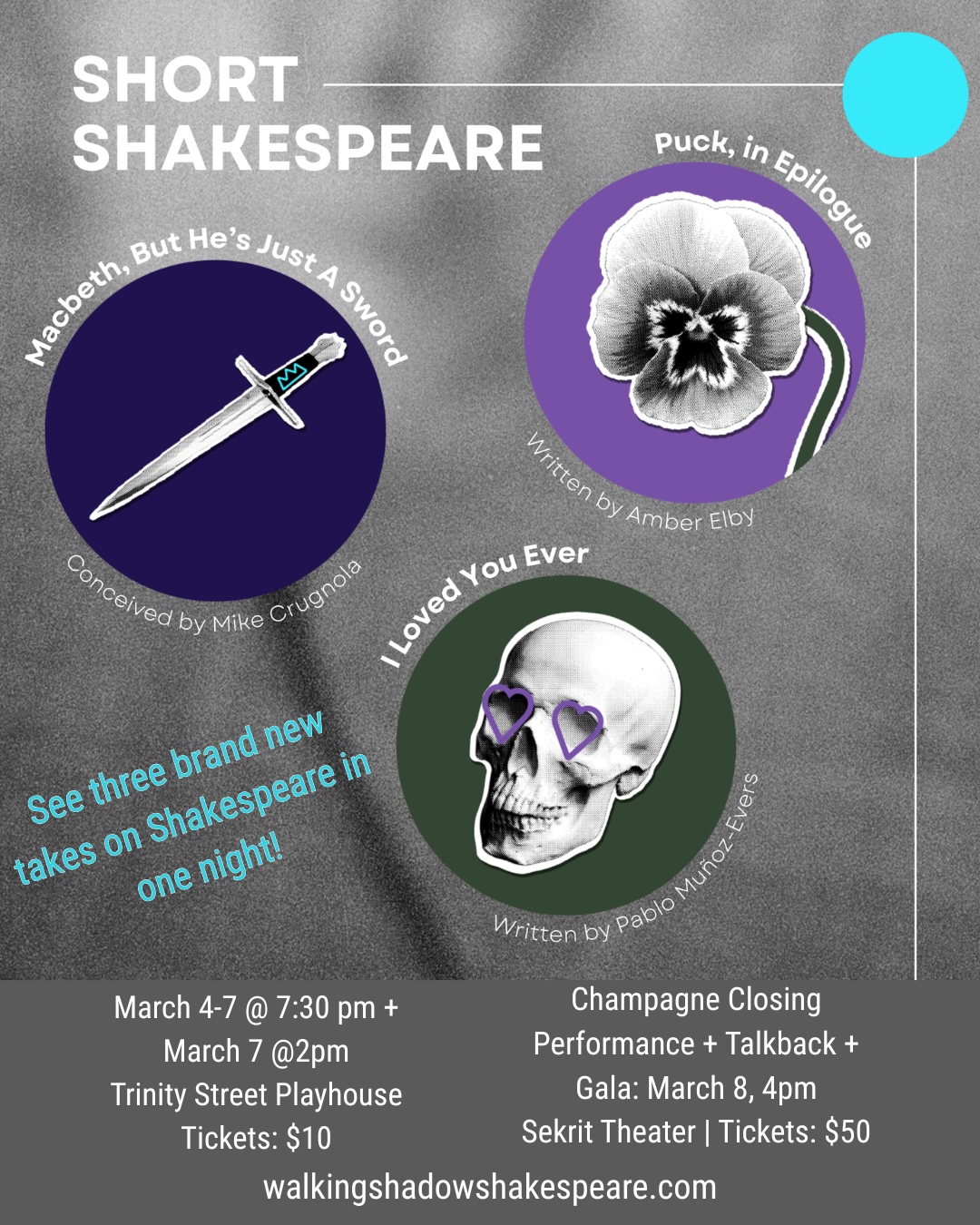
Review: Short Shakespeare - Three plays by Walking Shadow Shakespeare
by Michael Meigs
 Energetic and inventive, Austin's recently founded Walking Shadow Shakespeare Project has the enthusiasm of your favorably remembered high school group of "theatre kids." WSSP participants and the producers Mike and Steph Crugnola are full adults, experienced, and invested in the voluminous canon of Shakespeare's works. WSSP isn't going to bore you by joining the endless round of the most obvious plays.
I 've missed several of their innovative productions (listed at www.WalkingShadowShakespeare.com). And because I made a glitch in keeping my calendar, I very nearly missed last week's trio of short works derivative of Shakespeare. WSSP has more exotica on the horizon, by the way. In May, a single-live-rehearsal, single-performance outdoor staging of Coriolanus (a favorite of mine; they'll set it in 1830's Texas). In November, a staging of Henry IV, Part 1 in partnership with Austin's Scottish Rite Theatre.
 The three short works devised by WSSP playwright-adapters were entirely different from one another.
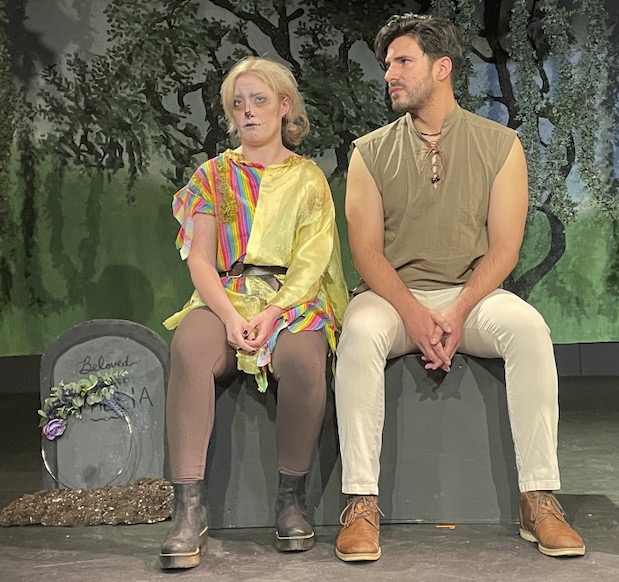
The opener "I Loved You Ever" by Pablo Muñoz-Evers features Hamlet and Laertes in an alt-plot, an approach similar to that of Tom Stoppard's Rosencrantz and Gildenstern are Dead. The scene is Ophelia's closed grave, where we meet a bedraggled, unidentified narrator, who departs the stage. Hamlet (Andrew Springer) discovers the tomb; Laertes (Muñoz-Evers) appears and attacks him. The melancholy Dane's protestation "I loved you ever!" surprises Laertes, his friend since their shared boyhood. The discussion, accusations, and discoveries that follow are, comically, in the tone of a couple of teenagers ragging one another in the high school cafeteria (an impression reinforced by the fact Hamlet is wearing a "do-rag"). The audience of Shakespearephiles certainly enjoyed it, repeatedly hooting in laughter at the incongruities.
One killer line delivered by Muñoz-Evers in the role of Laertes was "Yeah, poisons are my thing" (you had to be there!). Laura D'Eramo, earlier the unnamed narrator, reappears, this time recognized as the ghost of Yorick come from beyond the grave to tell these boys some home truths. D'Eramo uses subtle, clever movements that suggest that inside that costume, Yorick is really little more than wisdom speaking out of a bag of shifting disjointed bones. The resolution is an ingenious but wildly improbable plan to avoid the disasters of Act V, scene ii.
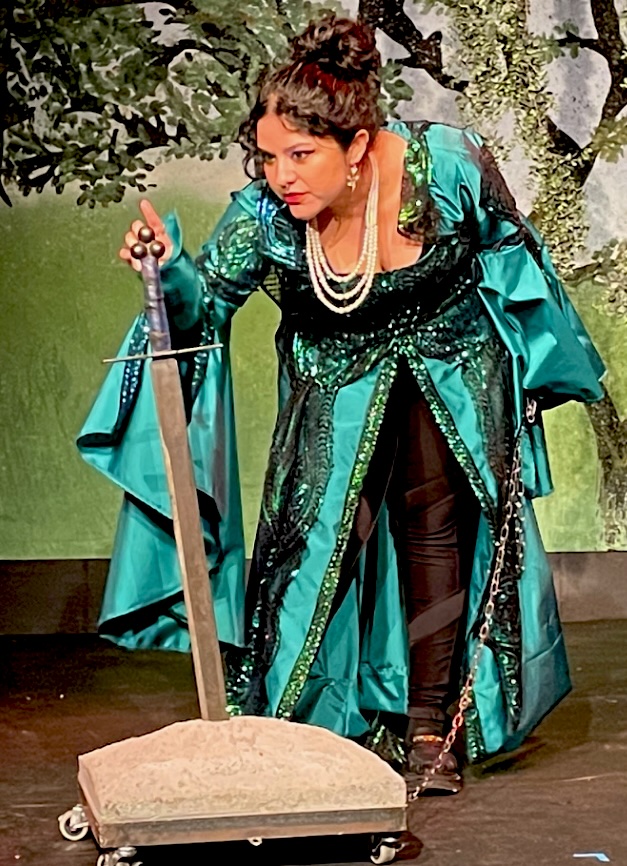 Mike Crugnola's concept for the second and longest of the three pieces is proclaimed by the title: "Macbeth, But He's Just a Sword." Pondering fate and free will, Crugnola began thinking of Macbeth the character as a tool of fate; delving further, he discovered that "Macbeth deposed Duncan and was well liked in Scotland, leading for 17 years of comparative peace. Duncan's son Malcolm ran to England and then came back with an army at his side." His question: if Macbeth was loved in Scotland, where did that army come from? He clipped familiar scenes from the text, transformed the title character to (literally) a sword, and intuited England rather than fate to be behind the dénouement resulted in a fifty-minute version.
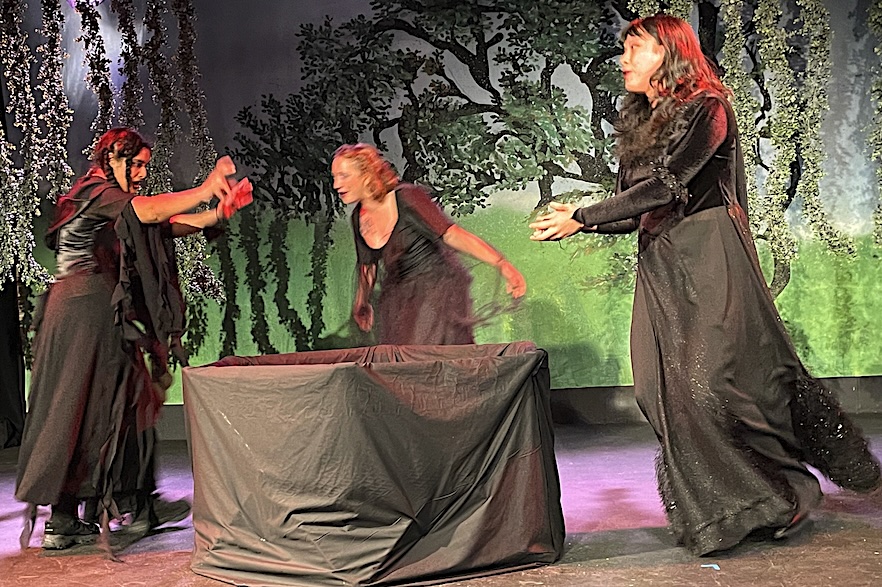
Kaylynn Yarelle as Lady Macbeth carries much of the early action almost solo, addressing that inanimate object. To be fair, Kyle Romero, offstage, is audibly articulate, but wasn't he reading from the script? I enjoyed the swirl of witches (Mayuri Raja, Samantha Plumb, and Juni Nguyen) and Oak Novielli's appearance and prophesy as the demon they evoked.
The company is confident with Shakespeare's words. Martha Neil as Malcolm, Julien Hemmendinger as Banquo, and Lee VIneyard as Macduff were particularly eloquent.
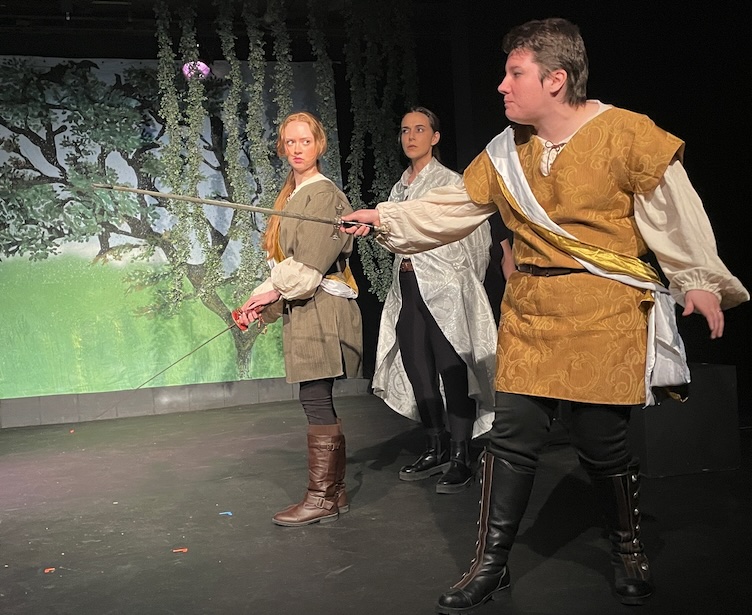
A fifty-minute Macbeth weighted with those concepts and without the benefit of changed dialogue or interpellated new speeches is a scramble. It depends upon the audience's knowledge of the original. With a text neither entirely articulate nor convincing about its intended message, in some respects this work resembled a "Classics Comics" version. You needed to absorb Mike Crugnola's program note before launching into the highlands.
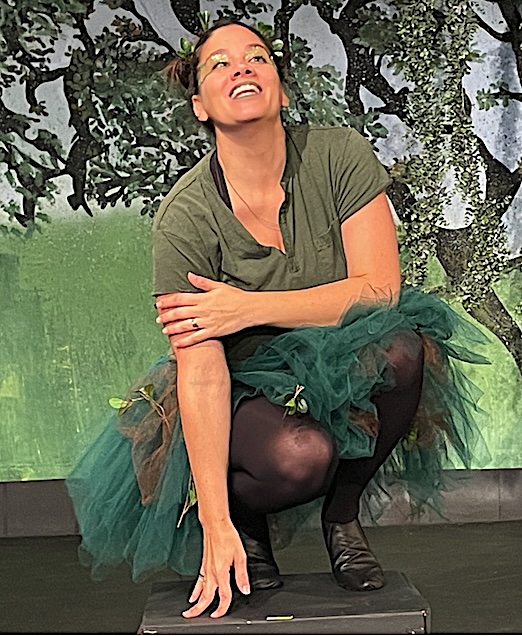 The finale, "Puck, in Epilogue," began behind the final scene of A Midsummer Night's Dream. Puck appeared, back to us, delivering the final speech ("If we shadows have offended,/Think but this, and all is mended,/ That you have but slumber’d here/ While these visions did appear. . .").
Finishing the bow with the appeal "Give me your hands," Stephanie Crugnola as Puck turns and appears visibly startled to see us there. It's meta-concept on top of meta-concept, and once Puck realizes we're not just figments, it's time to vamp. Any actor caught short of lines will recognize the feeling: What just happened? What's going on? What should I be saying to these people?
Amber Elby's play garnered a "Best of Fest" award at the 2026 Scriptworks/Hyde Park Theatre Fronterafest, where it was billed as a "one-mortal play." That's perhaps a misnomer, for Puck's a hobgoblin, a magical spirit who's certainly lasted 400+ years in Shakespeare's version and is almost certainly immortal, like Oberon and Titania, king and queen of the fairies.
Steph Crugnola totally inhabits this quicksilver being, talking fast, gesturing, tumbling, cajoling the audience with mimetic imitation. Gradually we pick up from his/her/their patter that all is not well in fairyland, where Oberon owns and controls everything and everyone. We hear that we, too, are imperiled, for the boundary between that magic realm and ours is all too permeable. Puck's word pictures tell of the heedlessness of kings, a particularly sore topic today, and the subjection of . . . well, subjects, both in fairyland and here. Puck, most of all.
Crugnola shines in this vigorous, balletic portrayal, both metaphorically and literally, for her eyes earnestly regard us through a painted mask of sparkles. She brings her Puck through confusion to confession to selfhood and agency. Would that we all could strive for such escape!
EXTRA
Click here to view the Walking Shadow Shakespeare Project program and artist bios.
Short Shakespeare - Three plays
by Pablo Muñoz-Evers, Amber Elby, William Shakespeare
Walking Shadow Shakespeare
March 04 - March 07, 2026
Black Box Theatre, 4th floor, First Baptist Church
901 Trinity Street
Austin, TX, 78701
March 4-7, 2026 at 7:30 pm, March 7 at 2 pm
Trinity Street Playhouse: 901 Trinity St, Austin, TX 78701, 4th floor of First Austin
Tickets: $10 Admission, available HERE
Special Event: Champagne Closing March 8 at 4pm. Sekrit Theater. Tickets $50.
Accessibility: We’ll be offering ASL interpretation on 3/6 and Live English Captioning and Audio Description on 3/7 at 2pm. All indoor performances offer Air Purifiers, free masks, free fidget cubes, and summary materials in English and Spanish.