Review: Heaven - Earth - One by Blue Lapis Light
by David Glen Robinson
The weather was cool, almost perfect for experiencing a site dance by Sally Jacques and Blue Lapis Light. It started late, as their shows always do. The scale and the complexity of these productions with their varied design fields, heavily dependent on technology, simply cannot mesh down to the minute of coordination. Plus last Sunday was the first public performance of the show; it was a new experience for all.
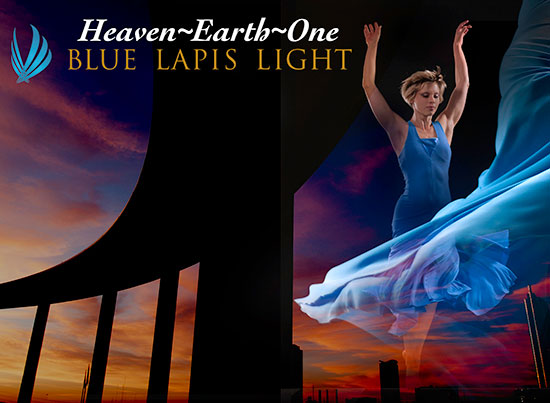
 But the performance promised immediately to be a very colorful show. The first performance segment was perhaps the most affecting. A lone human soul (Nicole Whiteside) danced somberly on terra firma when suddenly lights faded up on a celestial figure atop the arcing colonnade of the Long Center plaza (termed the Ring in the program) . The figure was positioned directly above the earthbound dancer and mirrored precisely the human’s movements. The figure danced by Theresa Hardy, guest artist of this show, could only have been the human’s guardian angel.
The color and light in which the two danced were spectacular, and that enchantment carried through the entire show. Lighting designer Jason Amato proved himself at least equal to the task of illuminating the monumental space of the Long Center plaza and helping solve the performance problems inherent to it. His painting in photons was powerfully imaginative, as always. Amato is privy to a semi-secret that others know but seem to employ but rarely in lighting design. It is that smoke or any other heavy, visible vapor will reflect light directed onto it. Amato released smoke from smoke machines on cue and then projected light patterns onto the smoke. Voila, patterns appeared in not-so-thin air. Performers made exits and entrances behind the patterns, seeming to disappear and appear magically. Such a simple concept, and used to such striking effect. I anticipate with pleasure many more awards for Jason Amato in the upcoming awards season.

At this point, please indulge a small digression. At its core, Heaven-Earth-One is a dance work. Jacques gained fame if not notoriety, however, for bringing into her shows elements of sports and recreation, notably in-line skating and skateboarding. Harness work with performers suspended freely or along high wall surfaces, employed the rigging technologies of alpining and circus acrobatics. Often it seemed that the climax of a Blue Lapis Light show was the moment when all these parts were on stage and moving at once. Through it all, Jacques described herself in her programs as a choreographer and director, and called these works dances.


These shows with all their diversity worked, but they revolved around a core of dance. Jacques brought in skilled choreographers such as Andee Scott, Laura Cannon, Theresa Hardy, Jose Luis Bustamante, now Nicole Whiteside and others to make them work. They found the spark of creative movement in roller blades and fishing nets. But the artistic core of a truly diverse work must hold the peripheries in perfect position for that work to be perceived as an integrated, expressive artwork. Sometimes in earlier Blue Lapis Light productions that central strength wasn’t there. In Heaven-Earth-One, dance came back strongly to reclaim its central position in this particular type of multiform site performance. This is why I give my personal laurel to this show as the best Blue Lapis Light performance so far.
The first ensemble dance on the plaza floor had more than a dozen dancers in bright costumes that were simple but almost majestic. Their numbers and energetic dance matched the monumental scale of the plaza, filling the place as well as our senses. The dance was one of advanced, abstracted modern technique, performed almost flawlessly (no apparent opening-night jitters) and full of athletic passages, varied pacing and complex floor patterns. The choreographic credit for the entire show is given to Blue Lapis Light, however, without suggesting any personal guiding vision for the individual dances. In most programs this general credit is taken to mean collective choreographic contributions by all the dancers. If this is the case here, then the ensemble is exceptionally well-matched and should be encouraged to create more dances. As far as individual credit may be extended to any work anywhere in the show, then guest artist Theresa Hardy appears to have transcended her technique, especially in her use of asymmetric shapes and the seeming infinity of movement phrases she can launch from them.
The longish dance was immensely satisfying, and as the light faded and the dancers exited between the columns directly upstage, we the audience could have risen to go home. But no, the harness work was just starting. And so it went for an hour that seemed like about forty minutes. I forgot the hardness of my bleacher seat. Harness work succeeded the dance, and dance with aerial silks succeeded the harness work.


Through it all, Jacques clearly expressed her ecumenical spirituality, finding, as many do, grains of truth and insight in all the world’s religions. The climax for me was in the second passage of the aerial silk work, performed by a couple between the central columns. The music here was the singing of the old church hymn “Be Still My Soul,” but updated lyrically and jazz-inflected. You know the one, “Be still my soul, the wind and waves shall know…” The credit for this arrangement was given to Paul Swartz, but the female voice singing it sounded very much like that of Tina Marsh, longtime musical collaborator of Jacques. I cannot be certain of this as the program did not specify. The song was a perfect blend of ecumenism, combining Victorian-age faith with 21st century Age of Anxiety doubt. To me, Jacques’ wisdom is that the answers are clear, but the Universe leaves them for every soul to find for itself.
I rarely tell everyone to come see a show, but I have to on this one. You will read and see videos of Sally Jacques and her shows for the rest of your life. But right now these shows are being performed by flesh-and-blood artists in our own city. All Blue Lapis Light shows present great opportunities to experience leading-edge fine arts. In Heaven-Earth-One the performances are by artists in full possession and play of their powers, their creativity flowing at flood stage. The inspiration they provide the audience is life-changing.
Review by Dawn Davis Loring for the Austin Chronicle, September 13
Review by Jeff Davis for austin.broadwayworld.com, September 12

EXTRA
Feature by Shelly Seale at www.austin.culturempa.com, September 4
Hits as of 2015 03 01: 1519
Heaven - Earth - One
by Sally Jacques and Blue Lapis Light ensemble
Blue Lapis Light