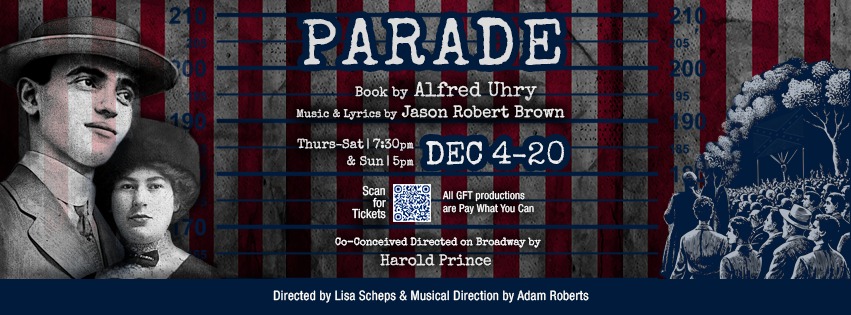
Review: PARADE by Alfred Uhry and Jason Robert Brown, Ground Floor Theatre, Austin
by Michael Meigs
 The disturbing themes of Alfred Uhry's Parade are intensified by Jason Robert Brown's score and by production values unsurpassed by Central Texas theatres of comparable size. This isn't musical theatre as we're used to it; it's a dark, dark story founded in actual events, one that presents characters full of nuance and ambiguity and offers no easy resolutions. Events begin with the murder of an innocent, a killing that is never resolved or even closely examined. Parade, titled for an annual Confederate Memorial Day celebration, quickly develops into a tale of revenge and the scapegoating of a man as innocent of the deed as the girl child who was killed.
It's not conventional musical theatre, although it was hailed in New York when presented in 1998. Parade is far closer to opera. Like the original events, it takes place in Marietta, Georgia from 1913 to 1915.
That setting struck me hard, for my eldest aunt lived, worked, and died in Marietta, a town northwest of Atlanta. It's about 150 miles from where I grew up.
A lesser writer could have taken the prosecution, sentencing, sparing, and eventual lynching of quiet, reticent Jewish factory manager Leo Frank to make a facile condemnation of the dark history of the post-Civil-War deep South. Narrow-minded, violent clans of stunted values . . . I'd have reluctantly accepted that, for I abandoned those places long ago.
But Alfred Uhry, born in Atlanta in 1936 to a family of German Jewish origins, knew more and knew better about the South. His lengthy list of works includes Driving Miss Daisy and The Last Night of Ballyhoo, both about throughly acculturated Jewish families in the South.
Some might call this impressive work a tragedy. They'd be right but for the wrong reasons.
Teenager Mary Phagan goes to Leo Frank's office to collect her pay, planning to meet friends at the cinema. She never appears. That night the janitor at the garment factory, her place of employment, is horrified to find her murdered body on the factory floor. Prosecutor Hugh Dorsey finds no clue that can identify culprit. Jewish factory manager Leo Frank is arrested, railroaded to trial on circumstantial evidence and coached testimony, sentenced to death, spared by the governor thanks largely to appeals by Frank's wife Lucille. The prisoner is sent to a penal farm to serve a life sentence. A handful of locals kidnap him at night and lynch him.
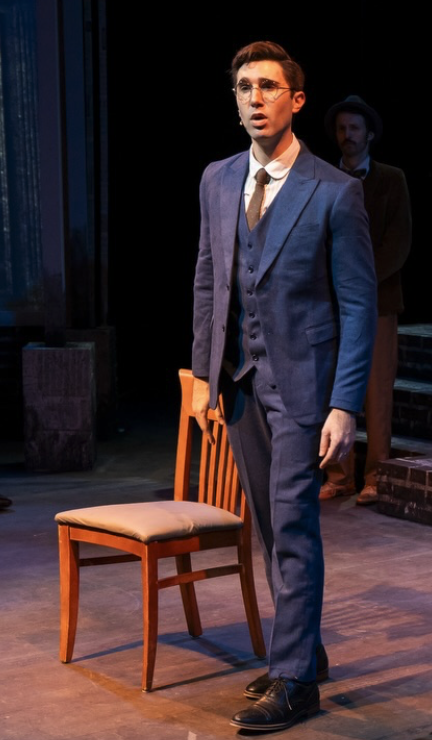
A fundamental principle of classic Greek drama: tragedy is the outcome of events precipitated by a mistake or fatal flaw of a heroic figure. Jacob Rosenbaum as Leo Frank is a reticent, quiet man baffled by the machinery of vengeance. He's not a hero, he's a victim.
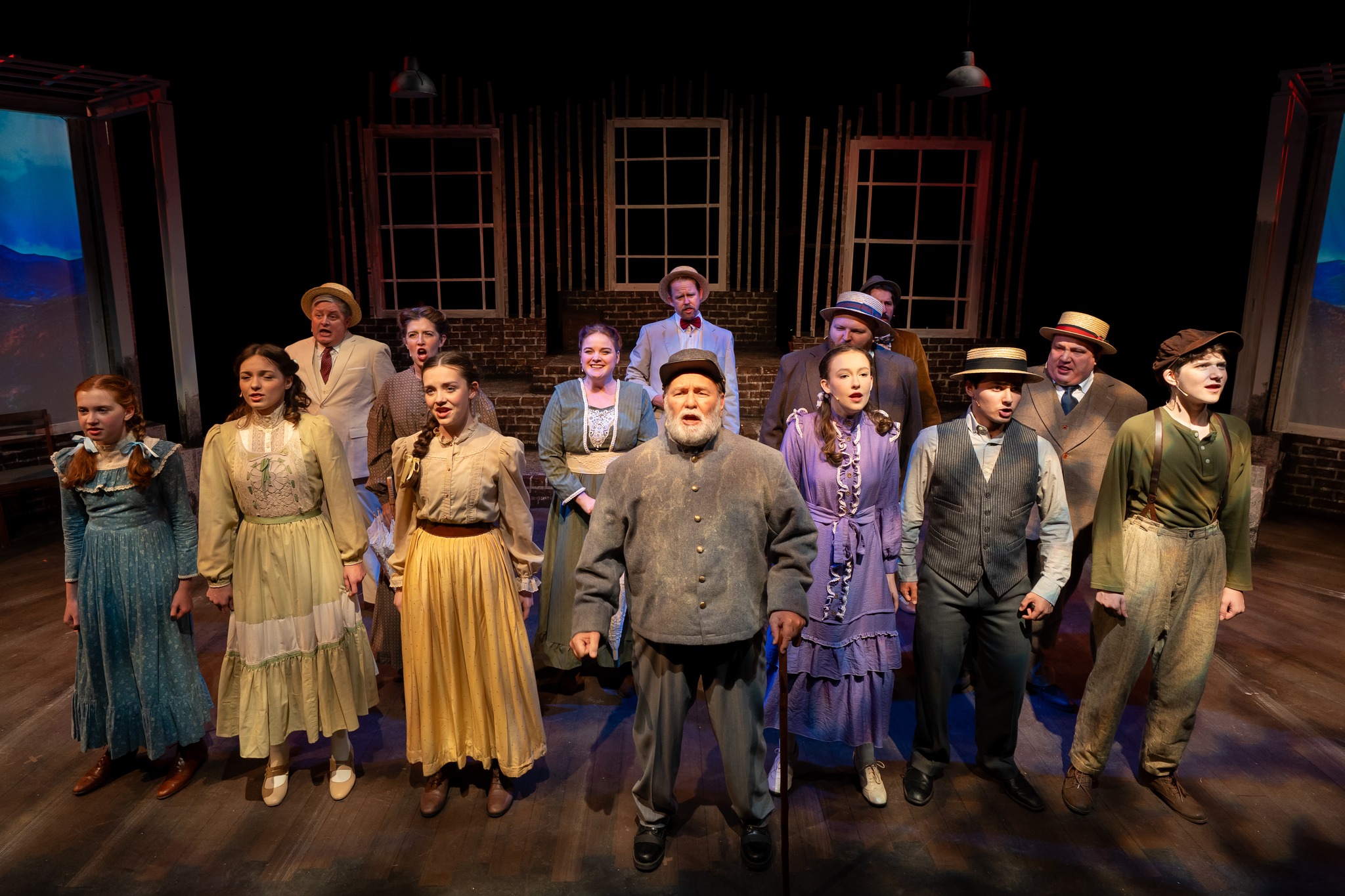
Uhry, indisputably a Georgia Southerner himself, depicts the townspeople of Marietta as a tragic figure incorporate. They're people of a small town proud of their heritage, eager to celebrate myths of the Confederate past. Large-scale, precisely choreographed musical numbers present the town to us. Each of the nineteen named characters is sharply drawn, and most are appealing. These aren't cameos; they're brilliant porttaits. Jana Zek's meticulous period costuming renders them startlingly vivid.
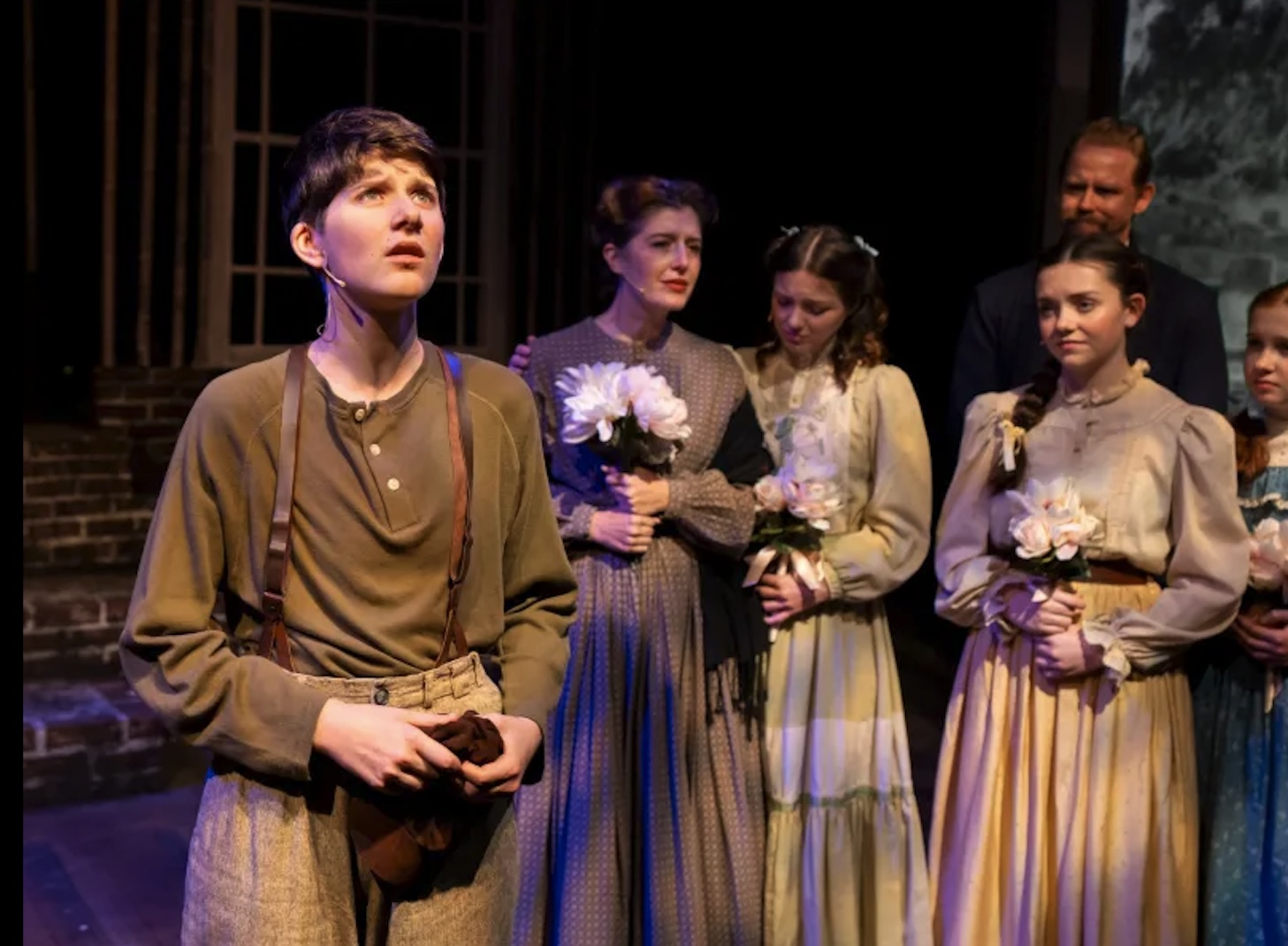
And what a cast.
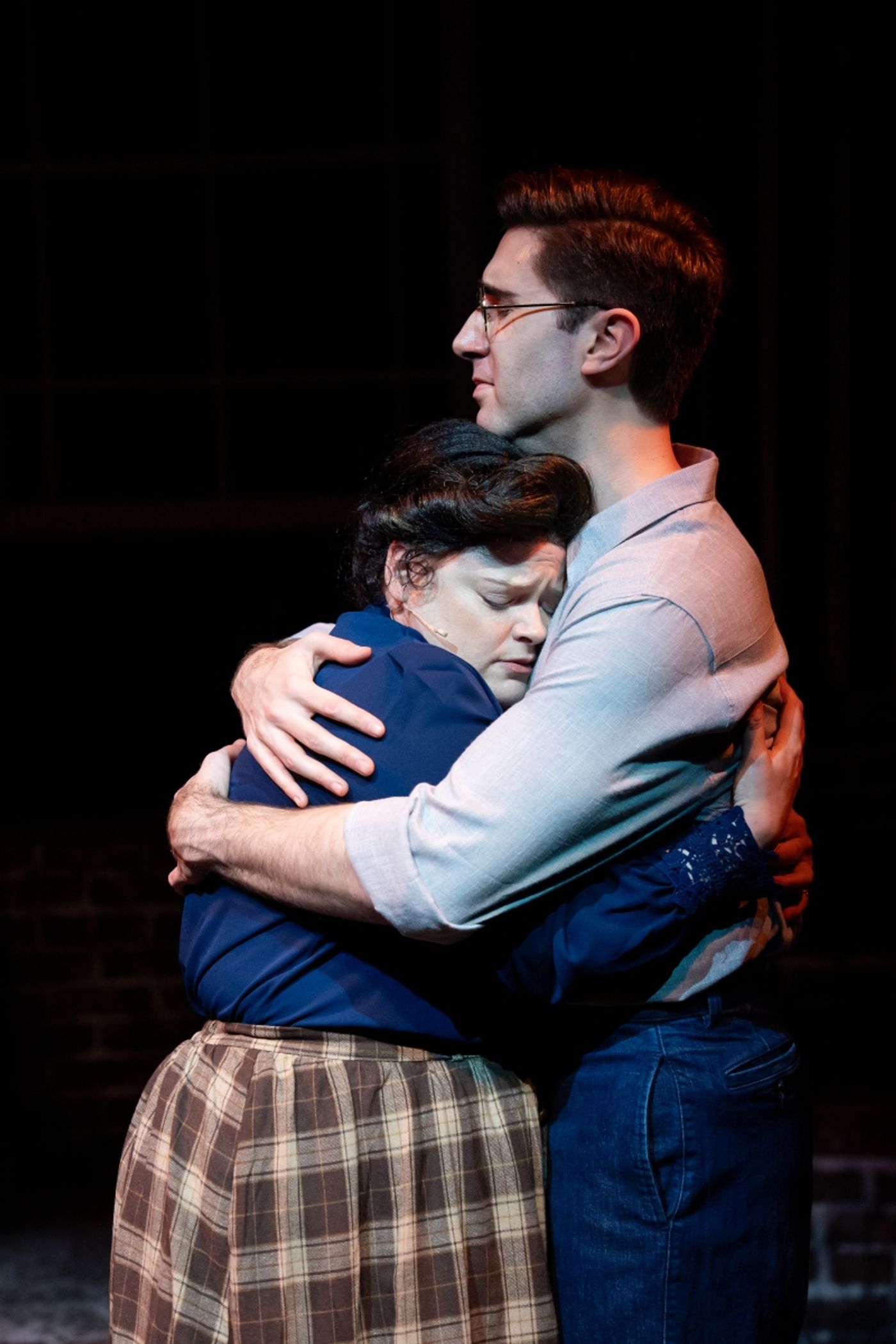
Rosenbaum as Frank is polite and bewildered; but in a fantasy sequence during the trial dramatizing factory girls' lies, he transforms into the leering, leaping Beelzebub the townspeople imagine him to be. Feller as his wife is earnest, vulnerable, and determined; they embody one important subtheme when long after the lynching, Lucille declares she'll never leave, for she's Georgia born and bred.
 Uhry constructs an entire society with his characters, from emotive John Christopher and Chelsea Manasseri as Blacks in menial jobs to portly, affable Adam Donmoyer in his white suit as Governor Slayton. There are villains, particularly Gannon Styles as publisher-kingmaker Tom Watson and Billy Gilbert as prosecutor Hugh Dorsey, both more interested in satisfying public anger and exercising power than in delivering justice. Juno McQueen as the murdered girl's boyfriend is a focused young actor with conviction and a fine voice. Nicholas Hunter's electrifying gospel-influenced agony as the coached, lying convict accuser Jim Conley (Nicholas Hunter) instantly lifted the story into the realm of good and evil so consistently ignored by the good townspeople of Marietta.
Unanswered questions hover above the action. Who was guilty? Who murdered Mary Phagan? That enigma remains throughout. And who, ultimately, is responsible for the murder of the innocent outsider Leo Frank? Were those midnight thugs acting for themselves, for the whole community, or for the power brokers? And how did an entire community fall victim to lies? That's a question that lingers still today. And not just about an event 110 years ago.
Ground Floor Theatre presented Parade ten years ago as a staged concert. The decade since then clearly provided lots of time for thought. Movement, music, and design are superb. Every detail of this complex undertaking created under Lisa Schepp's direction and Adam Robert's musical direction amplifies Uhry's themes.
Gary Thornsberry's simple set is stark but subtle; vertical white slats define the wall behind the raised rear platform. In celebrations they seem to glow like stripes on the wall of a circus tent; behind court room and prison scenes they evoke smalltown Georgia's inescapable system of (in)justice and incarceration.
This production is big, far bigger than GFT will be able to accommodate in its three-weekend, twelve-performance run. The second weekend sold out three days before performances resumed. If you don't snag a ticket in time, you still have the opportunity to view the streaming broadcast on Thursday, December 18.
EXTRA
Click to view the Ground Floor Theatre program for Parade
Parade
by Jason Robert Brown, Alfred Uhry
Ground Floor Theatre
979 Springdale Rd
Austin, TX, 78702
December 4 - 20, 2025
Ground Floor Theatre, Austin