AMADEUS - An Intrigue of Notes, by David Glen Robinson
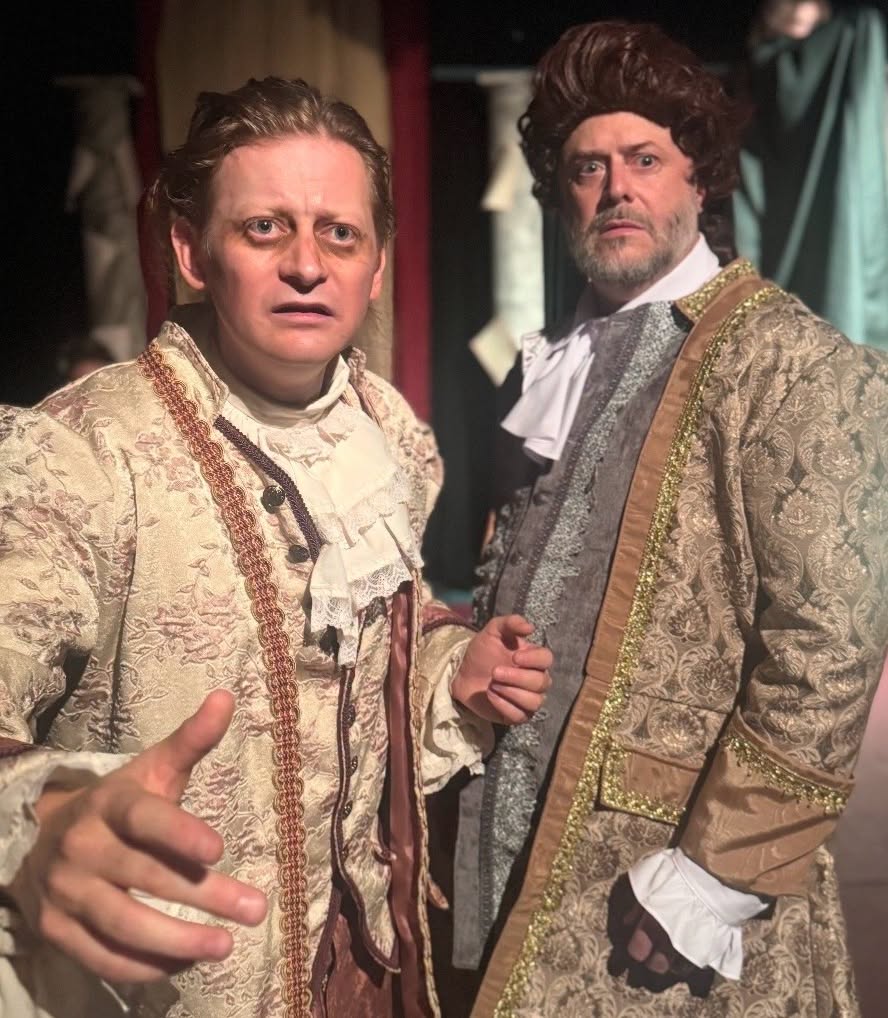 Austin’s City Theatre performances of Amadeus ended last Sunday, October 18, 2026. Readers may readily remember the play by Peter Shaffer, premiered in 1979 on Broadway and transformed into a cinematic triumph in 1985, winning the Academy Award for Best Picture the same year.
As a theatre reviewer for the online journal CTX Live Theatre in Austin, I would have loved to review the City Theatre production, but journalistic ethics forbade me. Why so? Because I auditioned for and won a speaking role in the play. I played Count Orsini-Rosenberg through all eleven performances of the three-week run. But ethics did not prevent me from assembling my thoughts, impressions, and feelings into a brief memoir of one actor’s inside view of a modern treasure of stage art, one personally fulfilling in many ways.
The play is historical fiction, the story of the conflict between Antonio Salieri and Wolfgang Amadeus Mozart. They did indeed know each other and interact in Vienna in the 1780s, in the Hapsburg court of Emperor Joseph II. Historical notes suggest their interactions were amicable, although late in life the possibly deranged Salieri claimed to have poisoned Mozart. Intrigues, eroticism, betrayal, sexual revenge, treachery, suicidal ideations, filth, corrosive jealousy, and hubris are the warp and woof of playwright Peter Shaffer’s fictional portrait of two composers, one of whom is recognized as the greatest musical genius of all time.
Certainly, this list of virtues and vices names the demons and sprites that swirled through every eighteenth century European court. Their mix in Amadeus is fictional, but art gets at larger truths, and there is plenty here for the twenty-first century to heed and learn. Referring to Aristotle one more time, paraphrasing: Poetry is superior to History because it gets at essences.
This Salieri started off in life by mistakenly placing his faith in transactional relationships, as many do. In the script, “I knelt before the God of Bargains, and I prayed through the mouldering plaster with all my soul.[1]” Salieri found success, thinking he had an alliance with God. And God, without doubt, is a major character in Amadeus, although He/She failed to make the dramatis personae list in the program. Salieri’s first contact with Mozart, a genius beyond measure, aroused corrosive jealousy in the older composer. Then Salieri’s faith turned to hate, and he became the enemy not only of Mozart but of God as well.
Not wise.
For me, there were several dramatic peaks in the story, notably Baron Von Swieten’s denunciation of Mozart’s The Magic Flute, a confrontation engineered by Salieri. But the absolute peak of the play and climax involved the title line. Salieri brandished a wooden chair over Mozart supine, humbled, demented, diminished, and blubbering. Salieri screamed “Amadeus!”, ready to deliver the final blow.
Mozart’s middle name in translation means either “lover of God,” or “beloved by God.” Either way, the use of it here is one of the best presentations of a title line I know of. For Salieri, Amadeus was accusation, a cry that God-given gifts of talent and success had been transferred from him to Mozart. By that simple divine act God destroyed Salieri, the denouement extending over several years. In her October 14 review theatre critic Sabrina Wallace of Broadway World Austin delved to the essence of this climactic nugget: “Ultimately, Amadeus reminds us that talent and wisdom do not necessarily go hand in hand, and that sometimes our greatest enemy is not the person standing in our way, but our inability to accept who we are.”
My BFF Carol, a choreographer, told me she liked best of all the play's choreography. Choreography? There was no choreographer listed . There were no dance rehearsals! Then it came to me. The ensemble/immersive design of the production created by director Bridget Farias-Gates had encouraged improvisational movement, especially on stage and in the house during the twenty-minute pre-show performance. The costumed cast took it from there, dancing and creating shapes in their stately promenades around the house.
 Couples danced alone or with other couples on the downstage left and right spaces kept open for entrances and exits. The women’s wide hoop skirts ballooned slightly, making beautiful spirals in their elegant gowns, slowly because of the limitations of space. The turnings and floating movements were like colorful flower petals floating on an elegant garden pool. Patterns in movement lengthened in time and space as the costumed characters moved across the stage.
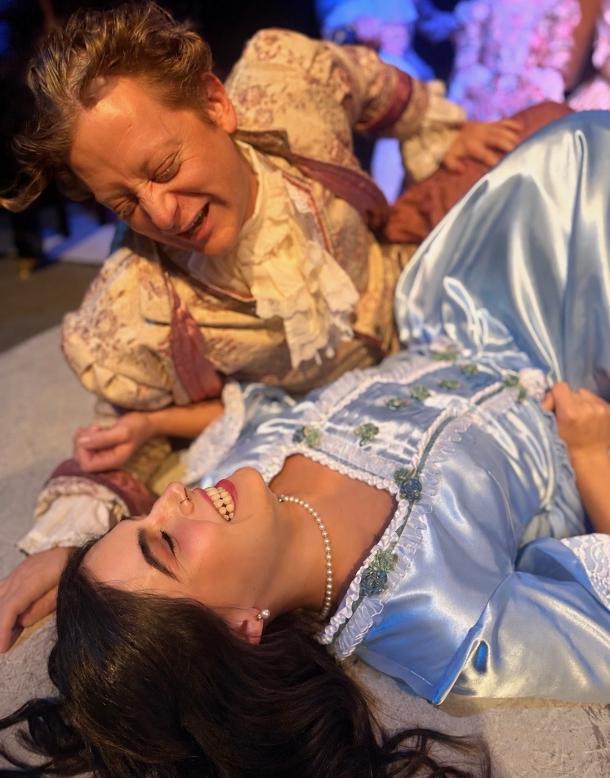
Mozart and Constance’s first scene flew from house right to house left, she in a spectacular blue gown, he in knee breeches and beige and brown brocade jacket. The scene was a flirty, erotic, playfully naughty introduction to both characters with a sado-masochistic undertone.
The action and costumes evoked a visual impression of Baroque interior designs with their extended lines and shapes with slight curves and framing curls on either end. These framing curls were throwdown bodies on the stage concealed discreetly by yards and yards of gown fabric and brocade. Any number of Baroque paintings, or paintings by Watteau or Gainsborough, came to mind. Choreographer Carol was correct. The choreography created another, higher level of meaning.
Daniela Recabarren played Constance (“Stanzi”) a Mozart by Brad Forsyth was Mozart. Their characters were memorable; as actors they have bright, bright futures. I’ll remember their names and follow their careers. Forsyth also played piano and sang small bits, notably in a piece of vocalizing by most of the cast in his highlighted encomium to vocal quartets.
Amadeus, surprisingly, is not a musical. Even more surprisingly, I did sing in it. Mozart’s music was piped in, coordinated with scenes from his operas.
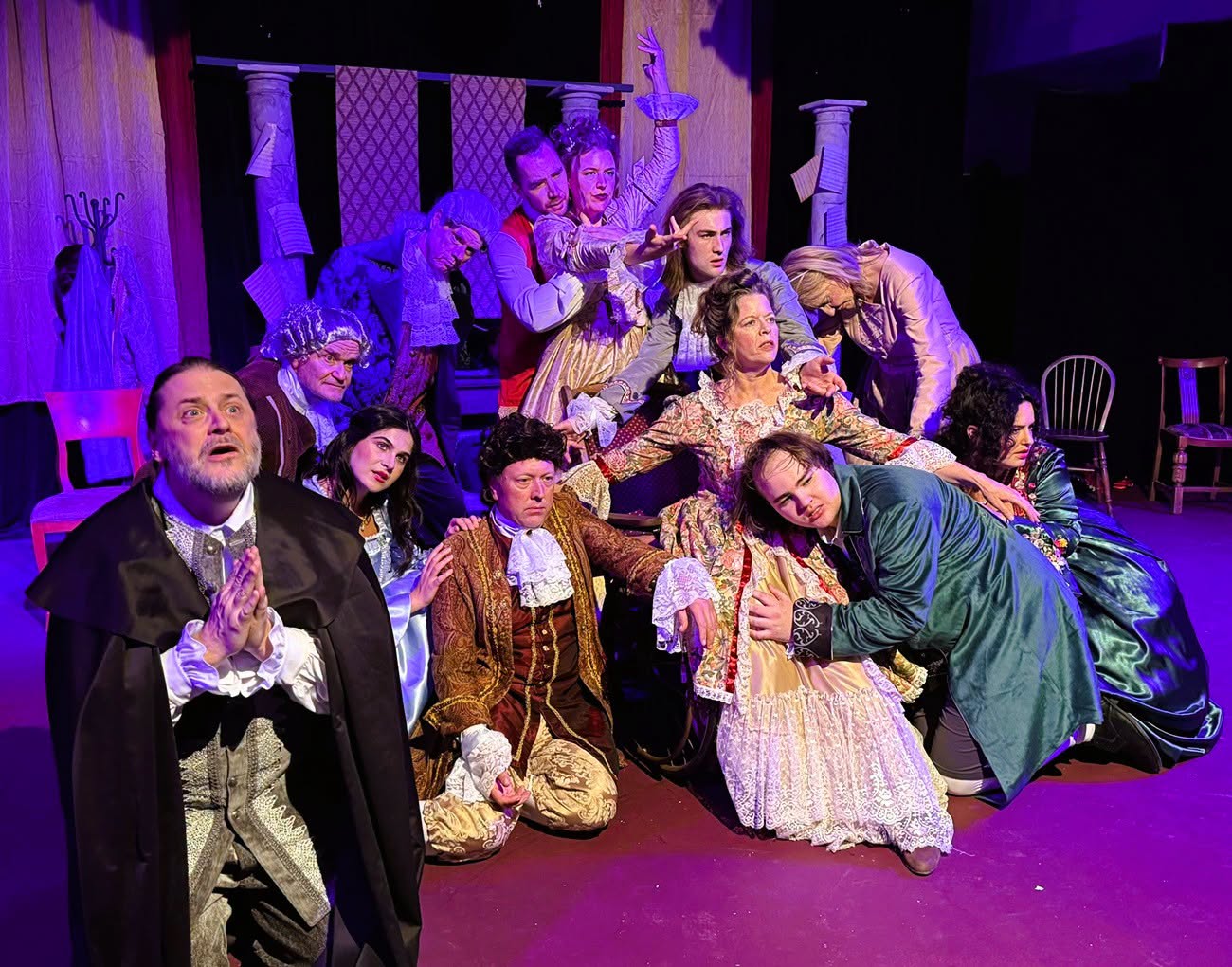
My participation as an actor through eleven performances, over three weekends (the Austin theatre standard), gave me a cast member’s closeup perspective, shared only by fellow cast members. The huge complexity of the work meant there were bobbles from start to finish. The stage blocking was challenging in the ensemble work, had to rush on and off stage on cue. Over time the actors adjusted some of their blocking to overcome problems. This is what directors mean when they and others tell the cast to take ownership of the show on premiere night and keep it until the end of the run. This cast did so happily. The result was progressively smoother and more confident presentations resulting in shorter run times, although the mean run time still hovered around the three-hour mark. Speaking personally, I cannot thank each of the cast members enough for creating this collective art with me, covering my dropped lines, pushing me into position when my blocking was off, and giving me throat lozenges when my voice was garbly. Thank you all.
As the cast learned and over-learned their characters and contributions to the story, each actor enriched the character with looks and gestures. Few such embellishments were scripted, but all were within character, and one hoped they eased the audience’s understanding of the dialogues.
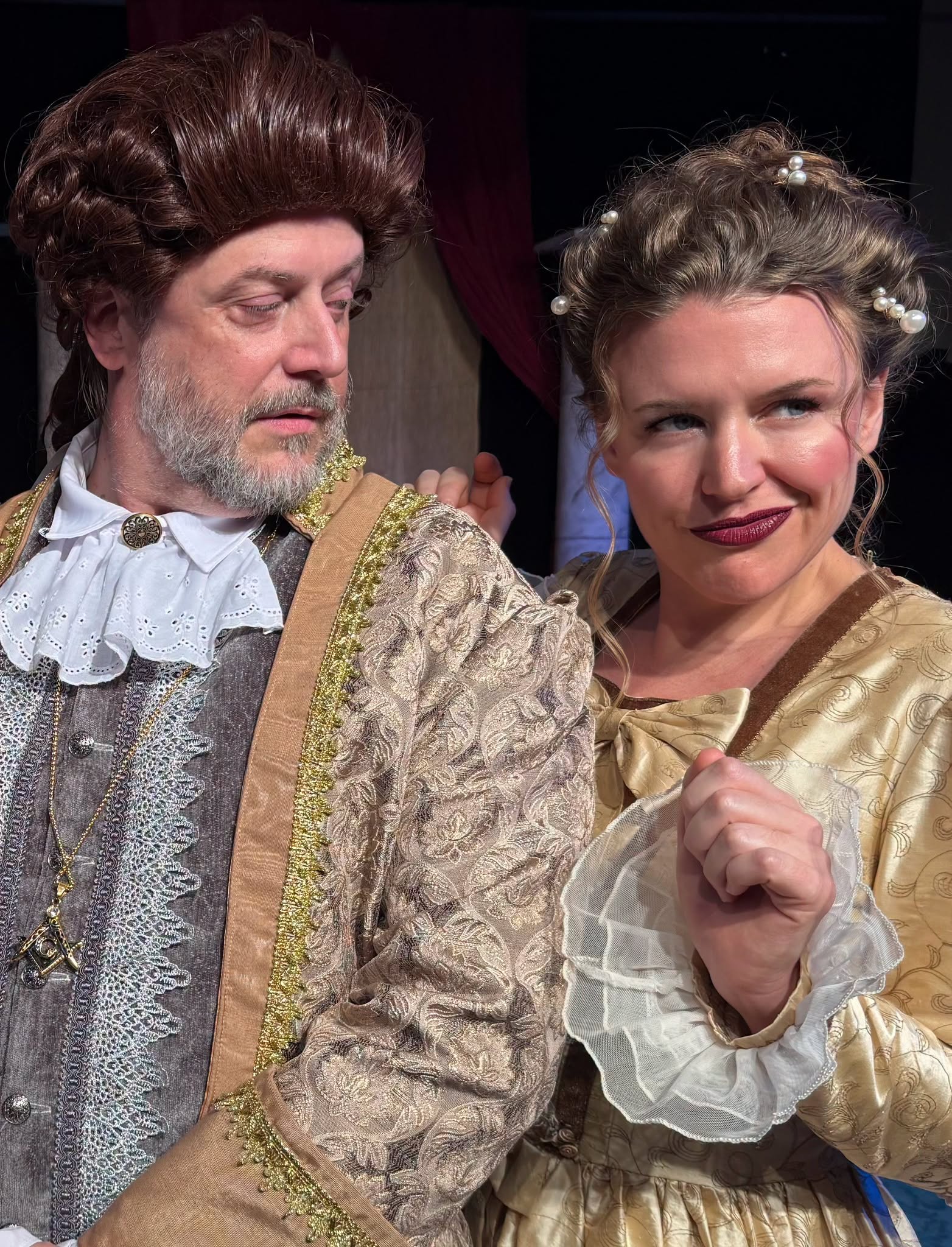 Kevin Gates’ Salieri was a monument of acting. He seemed tasked with thousands of lines. They filled the scenes with stories about Salieri’s feelings, God, and his desires for women, not to include his wife, played by Taylor Allen. Allen, playing the wife without lines, was nonetheless highly expressive. I enjoyed the wretched, sour facial expressions spreading across her face when Salieri mentioned his mistress, Katerina Cavalieri, played by Becky Richey. Subtle humor.
I cannot recount the entire play; I can only express my gratitude to all the actors who put it on and to Mollie Kirby, the light and sound board operator; Tracy Arnold, costumer and wig wrangler; and Ieleen Cerda, stage manager. There were other staff, techs, and artisans, but these three were with us from start to finish. And I cannot forget our goddess, director Bridget Farias-Gates, who picked and chose us, without whom we would have been nothing.
The actors:
Kevin Gates
Brad Forsyth
Daniela Recabarren
Willis Turco
Darren Scharf
Robert Fong
Tracy Hurd
Taylor Allen
Becky Richey
Aidan Thompson McTaggart
Mason James
Lee Santos
“Kiss, kiss, kiss” – Mozart.